Oiran
✎ 本文編集 (admin) 🖼 画像編集 (admin)“Oiran” works on DLsite
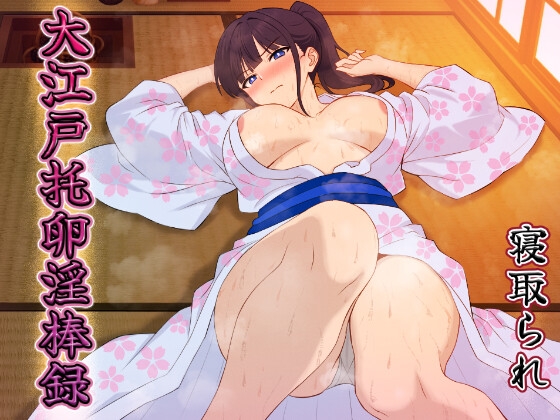

A vermilion uchikake, tate-hyogo hair, three-tooth clogs, and a foot stepping out in a figure-eight. With lanterns lit on both sides of the Naka-no-cho street, the spectacle of a star figure, attended by kamuro, heading to the ageya was one of the summits of urban art in early-modern Edo. Late-Edo ukiyo-e masters competed to depict her, and the women of the town imitated her hairstyles and obi knots. Where the Kyoto tayuu honed her art as an extension of court culture, the Edo oiran embodied a stylised beauty that townsman culture worked out on its own.
Oiran (花魁, high-ranking courtesan) is the name for the highest-ranking courtesan of the Edo-period Yoshiwara quarter. Narrowly it names the yobidashi-chusan; broadly it includes the upper ranks such as chusan and tsukemawashi. In the mid-eighteenth century, after the tayuu system that had held the summit effectively vanished, it settled in as the name for the highest rank. This article covers its emergence, the ranks, the stylised beauty, and its modern end.
Overview
The oiran stood at the apex of the early-modern Japanese pleasure-quarter system. Excellence was required across the whole range of learning (waka, linked verse, haikai, tea, flowers, incense, calligraphy, classics), the performing arts (shamisen, koto, dance), appearance, and bearing, and only those who passed through that training could reach the rank. Her fee equalled several years’ stipend of a low-ranking samurai, and the customer too needed the economic power of a samurai, daimyo, or wealthy merchant.
The oiran’s position was not that of a mere employee of a brothel but bore a quasi-self-employed character within the quarter. She was attended by her own kamuro, shinzo, and male attendants, held her own establishment and parlour, and could exercise a degree of choice over customers. A customer being “rejected” by an oiran became a representative narrative material of the quarter, frequently depicted in the works of Saikaku Ihara and Chikamatsu Monzaemon.
Etymology
Several accounts of the etymology of “oiran” exist. The most widely circulated holds it to be a contraction of “oira ga ane-san” (our elder sister): when the shinzo and kamuro referred to the senior courtesan who was their elder-sister figure, “oiran” settled in as the term for a senior courtesan. The account is recorded in early-modern sources such as the Morisada Mankou. The kanji “花魁” means “the vanguard of flowers”, the finest flower that blooms first, a metaphor of the senior courtesan’s beauty; it is an ateji (phonetic character usage) rather than a meaning derived from the character kai itself.
History
The highest rank of Yoshiwara was, in the early period (to the mid-seventeenth century), the tayuu. The tayuu transplanted the tayuu system of Kyoto’s Shimabara to Edo, fixed at a small number (around three at most in the Kanbun era), accompanied by the ageya system (an independent facility where customers summoned a tayuu).
But peaking in the Genroku era (1688–1704), the number of tayuu fell sharply. After the death of “Tamagiku”, the last tayuu, in 1751, the Yoshiwara tayuu effectively vanished. Behind this lay the loss of the economic base sustaining the tayuu, the decline of the ageya system and shift to the hikite-jaya (introducing-teahouse) system, the shift of the customer base from samurai to townsmen, and the difficulty of supplying courtesans of the required learning.
After the tayuu’s decline, Yoshiwara needed a new name for the highest rank. In the mid-eighteenth century, ranks succeeding the tayuu’s standing — yobidashi-chusan, chusan, tsukemawashi — were arranged, and “oiran” settled in as their general term. The yobidashi-chusan, the highest rank, went out to a hikite-jaya in response to a customer’s designation.
The oiran procession
The ceremony symbolising the oiran’s highest rank was the “oiran dochu” (procession). An oiran summoned by a customer paraded from her establishment to the hikite-jaya on the Naka-no-cho, attended by two kamuro, two furisode-shinzo, and male attendants. She wore tall three-tooth clogs and walked in the distinctive figure-eight gait (outer figure-eight in the Kyoto style, inner figure-eight in the Edo style). The procession typically took around thirty minutes, both a hospitality toward the high-paying customer and a display of the star figure to the whole quarter. Onlookers along the route studied her costume, hairstyle, and gait in detail and adapted them into town fashion.
Fees and clientele
The oiran’s fee varied by period; in the Bunka-Bunsei era (1804–1830), a yobidashi-chusan, including teahouse and bedding expenses, could reach five to six ryo for a night. Against a low-ranking samurai’s stipend (around eight to nine ryo a year for a 30-hyo two-person allowance), this was high consumption spending over seventy per cent of an annual income in a single night. The oiran’s customers were therefore limited to wealthy townsmen, high-ranking samurai, and the retainers of daimyo staying in Edo on alternate attendance. The custom requiring three visits — shokai, ura, najimi — before the bed was permitted was also a mechanism demanding long-term investment of the customer.
Decline and abolition
The Tenpo Reform’s austerity edicts (1841–43), the ensuing economic disorder of the late Edo period, and the collapse of samurai society at the Meiji Restoration rapidly stripped away the clientele and economic base sustaining the oiran. After the 1872 Liberation Edict for Performers and Prostitutes, the oiran’s status too was formally voided and replaced by the modern concept of “shogi”. Even so, the term “oiran” partly survived inside Yoshiwara through the Meiji period; the lineage of the last traditional oiran died out from the late Meiji to Taisho, and the term faded by the early Showa era. The 1958 full enforcement of the Anti-Prostitution Law ended the formal pleasure-quarter system itself.
Stylised beauty
The oiran’s uchikake was tailored from high-grade textiles — monsha, crepe, gold and silver brocade — with embroidery, dyeing, and gold-leaf decoration. A single robe could weigh around 20 kg and took over an hour to put on. The front-tied obi knot, overturning the convention of tying behind, became the oiran’s symbolic sign[citation needed]. The clogs were black-lacquered with three teeth, 20–25 cm high; the figure-eight walk was trained from the kamuro years.
The oiran’s hairstyle varied by period, with the hyogo-mage family (tate-hyogo, yoko-hyogo, date-hyogo, tsuru-hyogo) representative, marked by lavish ornament of many combs and hairpins. The ukiyo-e beauty pictures of Kunisada and Utamaro recorded these hairstyles and ornaments in detail, holding value as primary sources.
The oiran’s hospitality followed a strict form. At the shokai she did not share the bed with the customer, ending in a face-to-face meeting only; even at the ura (second) the exchange stayed superficial, and only at the najimi (third) was the bed permitted. At each stage formal gifts were exchanged. These forms were institutional devices positioning the oiran not as a mere sex worker but as an embodiment of urban culture with manners and learning.
Cultural influence
The ukiyo-e beauty pictures of Kunisada, Utamaro, and Harunobu took the oiran as a central subject. These works hold an important art-historical position as visual records of early-modern urban culture and as a source of influence on Western modern art through the Japonisme collections of the East-West exchange period (Monet, van Gogh). In literature, the oiran formed a central human type across early-modern genres: Chikamatsu’s lovers’-suicide plays, Saikaku’s ukiyo-zoshi, the ninjobon of Tamenaga Shunsui, and the yomihon of Bakin.
From the late twentieth century, reference to early-modern oiran culture continues in multiple fields: Moyoco Anno’s Sakuran (manga 2003, film 2007), museum exhibitions, and fashion-and-tourism “oiran experiences”. Fashion-field reference tends to be consumed in a way that bleaches out the harsh labour reality of early-modern oiran, and is sometimes criticised as commercial use lacking the perspective of those who lived it. This article describes from a standpoint that records both the stylised beauty and the labour reality.
Relation to the tayuu
The oiran inherited the lineage of the tayuu while taking a separate institutional form. The greatest differences are the geographic difference of the quarter (Kyoto versus Edo), the cultural background (court versus townsman culture), the hospitality system (ageya versus hikite-jaya), and the temporal sequence (the tayuu declined before the oiran appeared). In Kyoto’s Shimabara the tayuu rank survived formally into the late Meiji period, and traditional-arts inheritors styling themselves “tayuu” remain active today.
Ethical note
The oiran system was a brilliant occupational type symbolising early-modern Japanese urban culture, while standing at the apex of a pleasure-quarter system containing structural problems: indenture, human trafficking, difficulty of leaving, and violence within the quarter. Writing that extracts only the stylised-beauty side for nostalgic consumption risks overlooking the reality of the women placed in the quarter. This article describes from a standpoint that records both the cultural-historical value of the stylised beauty and the labour reality that underlay it.
Related terms
Updated
References
- 『Yoshiwara: The Glittering World of the Japanese Courtesan』 University of Hawaii Press (1993)
- 『Yoshiwara yukaku』 Chuko Shinsho (2012)
- 『Kinsei fuuzoku-shi (Morisada Mankou)』 (1837-1853)
Also known as
- oiran
- high-ranking courtesan
- ja: 花魁
- ja: 呼出昼三