Chitsu (vagina)
✎ 本文編集 (admin) 🖼 画像編集 (admin)“Chitsu (vagina)” works on DLsite





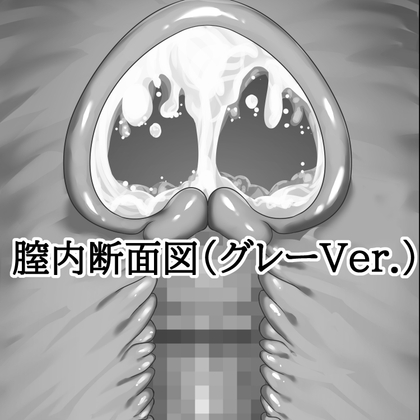


The obstetric examination chair, the contraceptive product package, the secondary-school health textbook. Many of the words concerning the female body converge on this single term. The pathway for menstrual flow, the principal stage of sexual intercourse, the canal for newborn passage at delivery. Few organs in the human body carry such a multiplicity of functions in a single structural form.
Chitsu (Japanese: 膣, chitsu; English: vagina; Latin: vagina) is the muscular canal forming part of the female reproductive system, connecting the cervix (cervix uteri) to the vulvar opening (introitus vaginae). The structure functions as the menstrual-flow pathway, the receptive canal in penile penetration during sexual intercourse, and the birth canal during delivery.
Distinction in vocabulary
The English vocabulary for the organ operates across a register-bifurcation. Vagina operates as the standard medical-and-everyday-formal term, with vaginal canal as the more specifically-anatomical compound. The vernacular vocabulary diverges substantially: pussy, cunt, and snatch operate in vulgar register with the more strongly-vulgar / more-jocular distribution differing across speech communities; womanhood and down there operate in evasive-euphemistic register. The English vocabulary’s strong register-bifurcation between clinical and vernacular is one of its defining features.
The Japanese vocabulary’s chitsu (膣) operates in clinical-medical register, with yoga-roji (与下路, “yoni-path”) and santeki (産道, “birth canal”) as related-clinical-specialised forms. The vernacular vocabulary is broad and registered: manko operates in vulgar register, hoto operates in folkloric-and-archaic register, asoko (“over there”) and are (“that”) operate as everyday-evasive-euphemism, mizoguchi (溝口) and similar slang-compounds appear in occupational and subcultural registers.
In sexual-aesthetic vocabulary, both languages elaborate the body’s interior sensation and the partner-experience-of-penetration into substantial vocabulary; English tight and warm parallel Japanese kitsui (きつい) and atatakai (温かい) registers. The cross-language vocabulary-comparison is complicated by the historical-cultural difference in obscenity-regulation regimes governing what register can appear in public-print.
Overview
The vagina is approximately 7-9 cm in anteroposterior length and 2-3 cm in lateral width, with substantial elastic capacity. Anteriorly, the wall is adjacent to the bladder and urethra; posteriorly, adjacent to the rectum. The pelvic-floor structural stability is set by these adjacency-relationships.
Etymologically, Latin vagina originally meant “sheath” (as in sword sheath), with the anatomical application a metonymic transfer. The Japanese chitsu (膣) is a Meiji-era medical-translation kanji, with the character constructed from the 肉 (niku, “flesh”) radical compounded with 室 (shitsu, “room / chamber”) — literally “chamber-shaped fleshy organ”.
Anatomical structure
Wall structure
The vaginal wall has four layers from inner to outer: (1) mucosa, (2) submucosa, (3) muscular layer, and (4) adventitia. The mucosa is stratified squamous epithelium, undergoing cyclical glycogen-storage-and-shedding under oestrogen influence. The mucosal surface shows characteristic transverse folds (rugae vaginales) that support tissue-stretching during intercourse and delivery.
The muscular layer is bilaminar (inner circular, outer longitudinal) with smooth-muscle-fibre bundles. The adventitia is loose connective tissue maintaining connection with adjacent organs.
Relations to adjacent structures
Anteriorly, the vagina is adjacent to the bladder (upper portion) and urethra (lower portion). The upper-anterior wall area corresponds to the G-spot region (discussed below). Posteriorly, the lower wall is adjacent to the rectum; the upper posterior fornix (Douglas pouch) communicates with the pelvic cavity.
The vaginal opening is surrounded on the inner side by the labia minora, on the outer side by the labia majora, anteriorly by the clitoris, and posteriorly by the perineum. The combined structures form the vulva. The muscular ring surrounding the vaginal opening (bulbocavernosus, ischiocavernosus, and related muscles) contracts during sexual response.
Hymen
The hymen is a thin membranous structure at the vaginal opening, with substantial morphological variation from infancy through puberty. The structure typically has an opening for menstrual flow and may undergo morphological change with intercourse, exercise, or tampon use. The traditional cultural framing of the hymen as a “physical indicator of virginity” diverges substantially from medical reality; this question is addressed in detail in a separate article.
Physiological function
Sexual response
The sexual-response cycle of the vagina was described by Masters and Johnson (1966) using the now-classical four-phase model (excitement, plateau, orgasm, resolution).
In the excitement phase, vaginal-wall transudate (vaginal lubrication) production begins, the inner labia and lower one-third of the vagina engorge, and the upper two-thirds expand and lengthen (“tenting effect”). In the plateau phase, lower-vaginal engorgement intensifies, and the vulva-as-a-whole takes a purple-red coloration. In the orgasm phase, rhythmic contractions of the lower vagina and pelvic-floor muscles occur at approximately 0.8-second intervals. In the resolution phase, engorgement and muscle tone resolve gradually.
Vaginal lubrication is a mixture of transudate from the vaginal wall and secretion from the Bartholin’s glands (greater vestibular glands). The objective fluid-volume measure of sexual arousal has been an investigated topic in correspondence with subjective arousal report.
Menstruation
During menstruation, endometrial shed-material passes through the cervix and the vagina to be discharged at the vulva. The vagina itself does not undergo structural change across the menstrual cycle, though oestrogen-regulated mucosal thinning-and-thickening and glycogen-storage-variation are observable.
Childbirth
During childbirth, the vaginal wall undergoes substantial stretching to allow newborn passage. The rugae-folded structure and the smooth-muscle-layer elasticity together support the stretching. Throughout pregnancy, tissue-remodelling progresses in preparation for delivery, with full elasticity reached at term. Post-delivery recovery typically restores most but not all of the pre-pregnancy form.
Sensory innervation and erogenous-zone function
Sensory nerve distribution within the vagina is non-uniform. The introitus and the lower one-third of the vagina have relatively-dense sensory-nerve-terminal distribution, functioning as the principal sexual-stimulation-reception region during intercourse. The upper two-thirds of the vagina has lower nerve density, with deep-pressure-sensation predominating.
A specific area of the anterior wall, the Gräfenberg spot (G-spot), has been noted since the 1950s as a region with high-sensitivity sexual response in some individuals. The anatomical-substantial status of the region remains academically-contested; contemporary anatomy increasingly frames the area as a compound territory of the deep clitoris and the Skene’s glands rather than as a discrete anatomical structure (Helen O’Connell’s 2005 systematic clitoral-anatomy research provides the principal evidence base).
The cervix-surrounding deep region (the posterior fornix area, portio vaginalis cervicis) operates as a deep-pressure-mediated sexual-stimulation region in some individuals. The Japanese industry vocabulary refers to the region as porchio (ポルチオ), a transferred reading of the Latin portio vaginalis cervicis.
Microbiology
The healthy vaginal environment is maintained by a lactobacillus-dominant flora with lactic-acid production, sustaining a mildly-acidic pH 4.0-4.5 environment. The acidic environment functions as innate-immunity protection against exogenous pathogen colonisation. The configuration is characteristic of the reproductive-age estrogenised vagina.
Disruption of the normal flora produces bacterial vaginosis or candidal vaginitis. The vagina also functions as the principal entry route for sexually-transmitted infections (chlamydia, gonorrhea, trichomonas, HPV, and others), making the structure a substantial public-health-relevant region.
Representation history
The vagina has been incorporated into the symbolic systems of multiple cultures since antiquity as a symbol of generation, fertility, and mystery. Ancient Mediterranean mother-goddess cults, East Asian yin-yang symbolism’s yin pole, and Hindu yoni-worship are representative examples of the religious-and-philosophical symbolic-encoding of the female external genitalia.
While modern medicine has achieved anatomically-neutral description, the cultural discourse around the vagina retains its ambivalent multiplicity. Second-wave feminist theorists critically examined the imbalance in male-centred medical description of vaginal anatomy and function. From the late 20th century, body-studies literature has been advancing a re-description trajectory that frames the vagina not as a “passive container” but as an actively-sensory-responsive organ.
Naomi Wolf’s Vagina: A New Biography (2012) is a feminist body-studies attempt to recontextualise the vagina across women’s-subjectivity, brain-neuroscience, and historical-discourse. Such re-evaluation discourse continues to intersect with anatomical and sexual-medicine research, producing an interdisciplinary field of contemporary vaginal-research.
Adult-content depiction
In adult-content production, the vagina operates as the principal stage of sexual activity and the central focus of visual composition. Close-up shot of the genitalia, depiction of the penetration scene, and depiction of vaginal-state-as-age-or-experience-marker (in virgin-themed, married-woman-themed, and mature-woman-themed genres) all incorporate the organ in genre-specific representational modes.
Vaginal ejaculation (nakadashi) depiction has been a major production-aesthetic mode in the AV genre, systematised from the 1990s onward. In dialogue with regulation-regime shifts, the convention has become one of the principal production-aesthetic categories in the contemporary AV industry.
Related Terms
Updated
References
- 『Williams Gynecology』 McGraw Hill (2020)
- 『Human Sexual Response』 Little, Brown and Company (1966)
- 『Vagina: A New Biography』 Ecco (2012)
- 『Histological study of the human clitoris』 Journal of Urology (2005)
- 『Come as You Are』 Simon & Schuster (2015)
Also known as
- vagina
- vaginal canal
- chitsu
- ja: 膣
- ja: 産道
- ja: ヴァギナ