Uterus (shikyuu)
✎ 本文編集 (admin) 🖼 画像編集 (admin)“Uterus (shikyuu)” works on DLsite

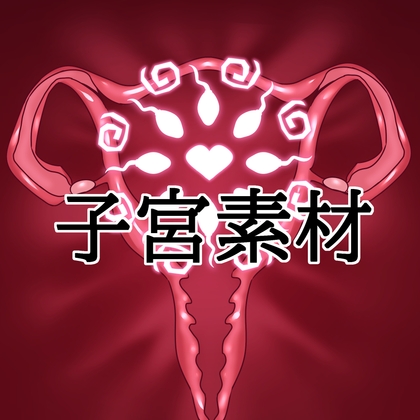






At the centre of the maternal body, deep in the pelvic cavity, at the hub of the reproductive system. It governs the rhythm of menstruation, holds the fetus through pregnancy, and sends the newborn out at delivery. The weight of the role this single hollow organ carries in a woman’s bodily history is beyond comparison with any other internal organ.
Shikyuu (Japanese: 子宮; Latin: uterus; English: uterus, womb) is the pear-shaped hollow muscular organ that forms the principal internal female genital organ. It lies in the centre of the pelvic cavity, between the bladder and rectum, continuous above with the fallopian tubes and ovaries and below with the vagina (chitsu). It carries the core functions of the female reproductive system: implantation of the fertilised egg, maintenance of fetal development, cyclical formation of menstruation, and contractile expulsion at delivery.
Overview
In a non-pregnant adult woman the uterus is roughly 7 cm in length, 4 cm in width, and 3 cm front-to-back. Its outline is an anteroposteriorly flattened pear shape, divided into a broad upper part (the body) and a narrowed lower part (the cervix).
Its functions comprise four reproductive stages: cyclical proliferation and shedding of the endometrium across the menstrual cycle, implantation of the fertilised egg and placenta formation, maintenance of fetal development during pregnancy, and contractile expulsion of the fetus through uterine muscle at delivery. A structural hallmark is the large variation in the organ’s size and functional state between the non-pregnant and pregnant periods.
Anatomical structure
From top to bottom the uterus is described in three divisions: the fundus (fundus uteri), the body (corpus uteri), and the cervix (cervix uteri). The fundus is the upper part where the fallopian tubes open from either side, the body the main central part, and the cervix the narrowed lower part continuous with the vagina.
The lower end of the cervix protrudes into the upper vagina and is surrounded by the vaginal fornix (fornix vaginae). The cervical canal runs through the centre of the cervix, opening above into the uterine cavity and below into the vaginal cavity. The vaginal opening is the external os, known in industry vocabulary as the “cervical opening” (shikyuu-kou).
The uterine wall has three layers from inner to outer: the endometrium, the myometrium, and the perimetrium. The endometrium comprises a functional layer and a basal layer; the functional layer proliferates and sheds monthly under the cyclical variation of oestrogen and progesterone, with the basal layer as the origin of regeneration. The myometrium is the wall’s principal component, a robust structure of interwoven smooth-muscle fibre bundles; uterine enlargement in pregnancy, contraction at delivery, and menstrual cramping all arise from it.
Anteriorly the uterus is adjacent to the bladder, posteriorly to the rectum. Between the uterus and rectum lies the rectouterine pouch (pouch of Douglas, excavatio rectouterina), the lowest part of the abdominal cavity, where fluid collects in peritonitis, intra-abdominal haemorrhage, or ascites. The uterus is suspended by several ligament systems (broad ligament, round ligament, uterosacral ligaments, cardinal ligaments) acting in concert with the pelvic-floor muscles.
The menstrual cycle
In the non-pregnant period the uterus shows cyclical endometrial change driven by ovarian hormone variation. The standard 28-day cycle is described in four phases: the menstrual phase (days 1-5), in which the functional layer sheds and is discharged as menstrual blood through the vagina and vulva; the proliferative phase (days 6-14), in which the functional layer regenerates and thickens under oestrogen; ovulation (around day 14), when the endometrium prepares for implantation; and the secretory phase (days 15-28), in which the endometrium becomes secretory and optimised for implantation under progesterone. If fertilisation and implantation do not occur, the cycle moves to the next menstrual phase.
Pregnancy and childbirth
When a fertilised egg implants in the endometrium, the uterus begins its pregnancy-phase structural change. Roughly the size of a hen’s egg in early pregnancy, it enlarges rapidly from the mid to late phase, reaching some 4-5 litres in volume at term. This expansion is achieved through hypertrophy and hyperplasia of uterine muscle fibres, remodelling of connective tissue, and increased blood flow.
The placenta is a temporary organ formed jointly by the endometrium and the fetal chorion, handling material exchange between mother and fetus. It usually forms over the fundus and body; when it forms in a low position it becomes placenta praevia, an obstetric complication.
Delivery is driven by the rhythmic contraction of the myometrium (labour), comprising progressive cervical dilation, passage of the fetus through the birth canal, and expulsion of the placenta. After delivery, uterine involution proceeds, generally restoring the non-pregnant size within 6-8 weeks.
Place in sexual response
The uterus is an internal organ, with visceral rather than superficial sensory innervation predominating. As a physiological response to sexual arousal, Masters and Johnson (1966) described “uterine elevation”, in which the uterine body rises within the pelvis as arousal builds, the upper vagina lengthens, and the space expands (the vaginal tenting effect). At orgasm, rhythmic contraction of the myometrium may be observed, in concert with contraction of the pelvic-floor muscles.
Deep-pressure stimulation of the region around the cervix is known in industry vocabulary as “porchio” (an abbreviation of the Latin portio vaginalis cervicis), a sexual-response area. Sustained pressure there produces a deep climactic sensation in a proportion of women, though individual variation in sensitivity is large.
Treatment in sexual representation
In adult representation the uterus is foregrounded in two distinct contexts. The first ties it to reproductive function: pregnancy, breast milk, fertilisation, and vaginal ejaculation (nakadashi). Depictions of semen reaching the uterus in internal-ejaculation scenes, pseudo-visualisation of fertilisation and implantation, and pregnancy-themed works fall in this category.
The second context foregrounds sexual stimulation of the cervix (cervical opening). Conventions referred to in industry vocabulary as “porchio play”, “cervix kissing”, and “cervix development” visualise climax through deep-pressure stimulation, developing especially from the 2010s in works aimed at women and at mixed audiences.
In manga and anime, the cross-section diagram visualising the uterus is established as a distinctive stylised mode in depicting sexual activity, prioritising symbolic and visual impact over anatomical accuracy as one of the characteristic visual languages of erotic manga and dojinshi.
Related Terms
- Vagina (chitsu) — the canal continuous with the cervix
- Vaginal ejaculation (nakadashi) — semen reaching the uterus
- Pregnant woman (ninpu) — the state of holding a fetus
- Breast milk (bonyu) — a linked female bodily function
Updated
References
- 『Williams Obstetrics』 McGraw Hill (2022)
- 『Gray's Anatomy』 Elsevier (2020)
- 『Human Sexual Response』 Little, Brown and Company (1966)
Also known as
- uterus
- womb
- ja: 子宮
- ja: 子宮口
- ja: 子宮頸部