Kuchi (mouth)
✎ 本文編集 (admin) 🖼 画像編集 (admin)“Kuchi (mouth)” works on DLsite







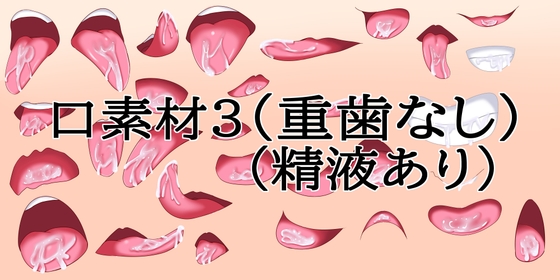
Lips part. The tongue is visible. Teeth in a line behind. Mucous membrane stretches further back. The mouth is among the most multivalent organs in the human body: where speech is produced, where food enters, where breath moves, where partners kiss, and where the genitalia of another may be received. In sexual contexts the soft mucosa of the oral cavity stands alongside the body’s other orifices as a central site of receptive sensation.
Overview
Kuchi (Japanese: 口, kuchi; clinical 口腔, kōkō) is the everyday Japanese term for the mouth, corresponding to the English mouth (general) and oral cavity (clinical). The Japanese term covers the whole region bounded by the lips (kuchibiru) at the front and by the soft palate and pharynx at the rear, taking in teeth (ha), tongue, hard and soft palate, cheek mucosa, the floor of the mouth, and the entrance to the throat (nodo). The organ carries speech, mastication, swallowing, breathing, taste, kissing, and oral-sexual reception, and it does all of this under voluntary control: unlike most of the body’s orifices, the mouth can be opened, closed, and shaped at will.
Anatomy and function
The oral cavity is bounded at the front by the lips, at the back by the soft palate and pharynx, above by the hard and soft palate, below by the tongue and floor of the mouth, and on either side by the cheek mucosa. The dental arches divide it into the vestibule (between lips/cheeks and teeth) and the oral cavity proper (medial to the dental arches). The mucosa is stratified squamous epithelium, thinner than skin and translucent enough that blood supply is visible through it. Innervation is shared across the trigeminal, facial, glossopharyngeal, and vagus nerves, producing the dense and finely differentiated sensory map that makes the mouth such an active sensual organ.
The functional range is wide. Mastication runs through the teeth. Swallowing engages the tongue, palate, and pharynx in coordinated sequence. Phonation uses the oral cavity as the resonating space for the larynx. Breathing passes through it as an accessory to nasal breathing. Taste arises from the lingual papillae and their taste buds. Kissing and oral-sexual contact use the same surfaces in a register entirely apart from any of the above. The voluntary control of mouth shape, opening, and movement is the structural feature that makes it the body’s most expressive sensual interface.
The mouth as erogenous zone
The oral mucosa and surrounding regions contain several distinct sensory zones. The lips are most sensitive to surface contact and are the centre of deep kissing. The tongue is a muscular-mucosal hybrid that operates on both sides of the contact, both as the active organ caressing the partner and as the passive surface being caressed. The hard palate carries strong tactile sensation and serves as the upper bound of the oral cavity during oral-genital contact. The teeth have less inherent sensation but enter sexual interaction as the agents of light biting and as the objects of being bitten. The capillary density of the oral mucosa is higher than that of skin, and the resulting flush of arousal — visible as colour change in the lips — has functioned as a visual marker of sexual excitation across cultures. Cosmetics that emphasise lip colour, from ancient red ochre through modern lipstick and gloss, are partly an enhancement of this natural signal.
Connection to oral sex
The mouth is the site of fellatio (fera), cunnilingus (kunni), analingus, irrumatio, and the target of facial cumshots (gansha). Oral-genital contact is documented across human cultures and across recorded history. The ancient Indian Kāma Sūtra (c. 4th century CE) devotes the ninth chapter of its second book — auparishtaka, “mouth-congress” — to a structured account of oral sexual practice. Medieval Christian Europe treated oral sex as a non-procreative act and a strong taboo, subject under sodomy law to severe penalty. Edo-period Japanese enpon described oral practice with vernacular nicknames such as awabi no kuchi (“abalone mouth”) and shakuhachi (after the bamboo flute), treating it less as taboo than as material for humour and visual pun. Contemporary adult video, doujinshi, and eromanga have made oral sexual representation a baseline rather than a margin: many works place oral sex at the centre rather than the periphery of the act.
Why the mouth carries the sexual charge it does
Several distinct reasons converge. First, the mouth is the centre of speech and expression, and any voluntary relinquishment of that control to another person reads as a strong sign of intimacy. The closed-mouth diplomatic register of public life is suspended; what is offered instead is the surface used for talking, in another register entirely. Second, the oral cavity shares mucosa-and-orifice structure with the body’s other openings (the anus (koumon), the genitalia), while remaining visually accessible from outside in a way the others are not — it can function as a visible proxy for surfaces normally hidden. Third, the surrounding grooming — the colour of the lips, the alignment of the teeth, the whiteness of the smile — works as a powerful index of social standing and health, with attendant sexual signalling.
The stability of the fellatio genre as an independent category in the adult-media market draws on this layered psychological grammar. The mouth occupies a structural position that the other erogenous receptive sites do not: it is the place where speech and sex meet, and that meeting is the source of its distinctive position in the broader sexual vocabulary.
Derived expressions
The Japanese vocabulary supports a number of euphemistic and figurative uses of kuchi in sexual register. Kuchi de suru (“to do it with the mouth”) is the common euphemism for oral sexual contact. Kuchi ni dasu literally means “to put into the mouth” but in slang use refers to oral ejaculation, in parallel to its everyday sense of “to say aloud”. Kuchi ga umai (“to have a clever mouth”) is read with light double-meaning, covering both verbal skill and sexual skill. Ii kuchi (“a good mouth”) functions in adult-industry slang as a quality compliment in the context of oral technique.
Western parallels and contrasts
English vocabulary differs in register: mouth is the everyday term and oral cavity the strictly clinical one, but English does not pack the same range of figurative-sexual senses into the bare word that Japanese does into kuchi. The English vocabulary’s sexual register for the mouth is carried mostly by the act-names blowjob, oral sex, eating out, and kissing, rather than by the noun for the organ itself. The Japanese vocabulary’s tendency to extend the noun kuchi across speech, expression, sexual practice, and metaphor, often in the same phrase, is a stylistic feature of the language that English-language adult writing has no exact equivalent for.
Related Terms
- Kuchibiru (lips) — the entrance and most surface-sensitive zone
- Ha (teeth) — the dental component
- Nodo (throat) — the inner continuation
- Fera (fellatio) — receptive oral practice on the male partner
- Kunni (cunnilingus) — receptive oral practice on the female partner
- Deep kiss
- Irrumatio
- Gansha (facial cumshot)
Updated
References
- 『Atlas of Anatomy』 Thieme (2020)
- 『Gray's Anatomy for Students』 Elsevier (2019)
- 『Eroticism: Death and Sensuality』 City Lights Books (1986) — Original French Death and Sensuality, 1957.
- 『Kama Sutra』 (c. 4th century CE) — Book II, Chapter IX 'Auparishtaka' covers oral congress.
Also known as
- mouth
- oral cavity
- lips and oral region
- ja: 口
- ja: くち
- ja: 口腔