Action Eroge
✎ 本文編集 (admin) 🖼 画像編集 (admin)“Action Eroge” works on DLsite



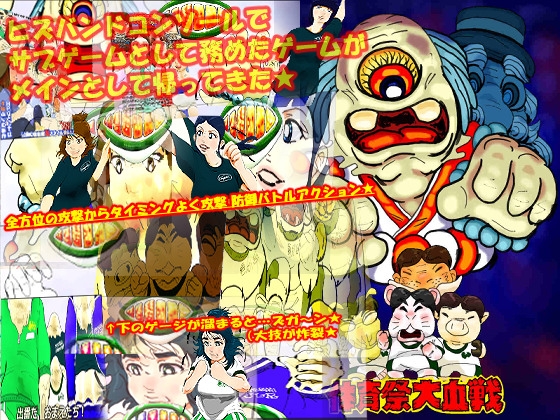


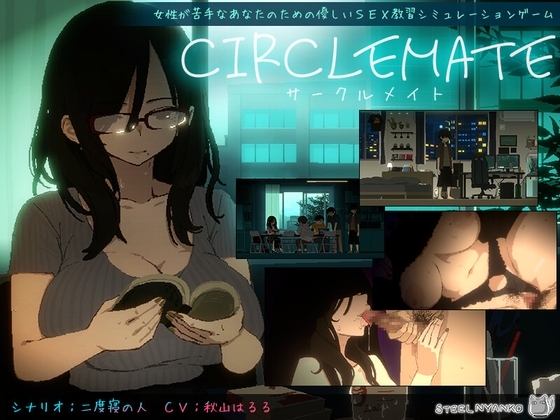
A character on screen swings a sword in response to button presses, dodges, gets surrounded by enemies, and on losing the encounter the screen fades to a defeat scene. Action eroge is the genre, settled across the 2010s in the Japanese doujin-game scene, in which the player’s operational skill at the game and the sexual scenes of the work are tied directly to each other.
Overview
Action eroge (アクションエロゲ, akushon eroge; also action-gē or doujin action) is the umbrella term for adult-content games whose principal gameplay system is real-time action — side-scrolling action, beat-em-up, 2D fighting, top-down action, metroidvania-style exploration. The narrow sense restricts it to action-system eroge and adult doujin-games; the broad sense covers all real-time-operation adult games that do not adopt the novel / adventure system.
The structural elements of the genre are three: (a) real-time control of a character (movement, attack, dodge, jump); (b) alternation of combat / exploration sections with sexual scenes; (c) operational outcomes (defeat in combat, satisfaction of a particular condition) that trigger the sexual scenes. Where novel-style and adventure-style eroge work primarily through text choices and reading, action eroge tie sexual content tightly to the moment-to-moment outcome of play.
The genre’s principal site is the doujin-game scene rather than the commercial eroge industry. The spread of low-cost development tools (Unity, GameMaker, Wolf RPG Editor, Tyrano Script) gave individual circles the capacity to produce a side-scroller, a top-down action, or a 2D fighter at an order of magnitude lower expense than a fully voiced commercial novel-eroge. With DLsite and FANZA as the principal sales platforms, dozens of new titles per month enter circulation.
The standard configurations in the adult-content register are (1) the defeat-scene system, in which the player’s character losing an encounter triggers a sexual scene; (2) the capture system, in which the antagonist captures a heroine and a sexual scene results; (3) the transformation system, in which a body change (TSF, succubus mutation, tentacle adoption) is itself the theme; (4) the raid-and-pillage system, in which a village or city is overrun and the inhabitants subjected to a sexual scene. The slot is consolidated in the doujin and indie register more than in the commercial industry.
Etymology
The English action is the upper-category game-industry term for real-time-operation games, in use since the arcade-game generation of the late 1970s, and covers shooters, fighters, platformers, and hack-and-slash as a single umbrella. Action eroge is a transparent compound of this term with eroge. It has been the industry term since the late 2000s.
The colloquial form akushon-gē uses gē as the standard doujin-shop short for gēmu (“game”). It is in the same series as ero-gē, nuki-gē (a stroke-game; an adult game produced primarily for arousal), and naki-gē (a cry-game; an adult game where the narrative pull is in the emotional resolution).
History
Early 1990s: action elements inside commercial eroge
The prehistory of commercial action eroge sits with the PC-9801 generation of early-1990s Japanese personal computers. Alice Soft and Elf, the leading commercial eroge makers of the period, produced primarily novel-and-adventure titles but also released a number of works that built in action, shooting, or puzzle sub-systems. Alice Soft’s DPS Zenbu and Toushin Toshi (1990), Pro Student G (1991) are the standard references; they were not pure action games but multi-system compounds, and they set the substrate for later doujin action eroge.
2000s: the doujin-game scene takes shape
In the 2000s, the rise of consumer-grade PC computing power together with the spread of doujin-game tools (Wolf RPG Editor, 2008; GameMaker, Unity) enabled the production of fully featured action games at the individual-circle scale. Among the canonical works of the period, Mephisto’s Kunoichi Ninpōchō (2006) is one frequently cited as anchoring the action sub-genre in the doujin scene.
DLsite became the principal distribution platform for doujin games, and a structure in which low-priced (¥1,000–2,500) large-volume action eroge could be supplied continuously by small circles became established.
2010s: the doujin-action-eroge boom
Through the 2010s, action eroge consolidated as one of the principal sub-genres of the doujin-game market. Side-scrolling action, top-down action, 2D fighting, metroidvania-style exploration developed in parallel.
The defeat-scene format (the player losing leading to a sexual scene), the tentacle-system, the TSF-transformation system, the magical-girl-fall system, and a number of related sub-genres separated out as independently categorised. The lineage developed as a doujin-side expressive format distinct from the trajectory of the commercial novel-style eroge industry.
2020s: Steam and international circulation
From the 2020s, the partial opening of Steam’s adult tag, the spread of Itch.io, Patreon, and SubscribeStar, and the development of international indie-adult-game platforms have driven the English translation and international circulation of Japanese doujin action eroge. Inflows of English-language indie-adult-action works have proceeded in parallel, and the market has become more two-way.
Standard configurations
Defeat-scene system
The configuration most characteristic of action-eroge is the defeat-scene (sometimes defeat sex in English-language documentation). When the player’s character is defeated in-game, the defeat triggers the transition to a sexual scene. The format has three design-effects: (1) the player’s operational shortcoming becomes a trigger for sexual content; (2) the player’s failure operates as a narrative beat; (3) repeated playthroughs become a way of collecting different defeat scenes. Since Mephisto’s Kunoichi Ninpōchō the defeat-scene has functioned as the doujin-action-eroge centre of gravity, and is treated as a research topic in game studies in its own right.
Capture / restraint system
The configuration in which an antagonist captures and restrains a heroine and a sexual scene follows constitutes a separate sub-genre. The player’s mechanic of attempting escape, the post-capture staged transformation (mental change, training), and similar variations combine multiple-stage gameplay with the sexual register.
Exploration / collection system
The configuration that embeds sexual scenes in the dungeon-exploration and item-collection loops of metroidvania-style action is in wide use. Area-by-area gradual unlock, condition-satisfaction scene unlocks, hidden-area and hidden-event collection structures: these integrate the pleasure of exploration with the pleasure of scene collection.
2D fighting / versus system
The line of works that adapts 2D-fighting systems to the adult-content register is also an independent sub-genre. Defeat-on-loss sexual scenes, special-move and grapple-move sexual contact, multi-character pairing variation: the system properties of the fighting genre are turned to expressive ends.
Succubus / monster-girl system
The line of works that builds on a fantasy world-setting, a succubus / monster-girl framing, or other non-human-species design constitutes a principal derivative of the action-eroge genre. It runs alongside the fantasy and isekai lines as a confluent region, and integrates world-design, character types, and sexual-scene staging in a single combined idiom.
Adjacent categories
Difference from action RPG
Action RPGs are turn- or command-based role-playing games at base; action eroge requires real-time action gameplay. A hybrid (action RPG with eroge content) exists on the boundary.
Difference from novel-style eroge
The novel- and adventure-system commercial eroge line works on a text-led narrative model and does not require operational skill from the player. Action eroge is built on the coupling of operational skill with progression, which is a quite different design.
Difference from training / management adult games
Training- and management-system adult games work on a long-term simulation of character development, which is a separate gameplay design from real-time action. Composite works that build action sections into a training game (training + action) exist on the boundary.
Difference from commercial eroge
The commercial eroge industry has been dominated by novel- and adventure-style works, with the action segment as a minority share. The reasons cited for the action-eroge concentration in the doujin sphere include (1) lower per-title production cost for action than for fully voiced commercial novel-eroge; (2) the affinity of indie game-engine tooling with action systems; (3) commercial publishers’ business judgement that novel-style work is more reliably profitable.
Cultural notes
A principal axis of the doujin-game market
Action eroge has been one of the principal axes of the doujin-game market since the 2010s. The DLsite and FANZA monthly rankings, especially the long-running cumulative-sales lists, are consistently held in the upper bands by action- and RPG-system titles.
Connections to international indie
In the English-language indie scene, the Patreon and SubscribeStar subscription platforms support an independent market for adult-action development. Japanese doujin action-eroge and English-language indie adult-action share their technical bases (Unity, Godot) and their sales platforms (Itch.io, Steam), while differing in expressive style and character-design line as parallel-developing fields.
The democratisation of game development
The action-eroge market’s growth is a tightly correlated phenomenon with the broader democratisation of game-development tools. Free or low-cost engines such as Unity, GameMaker Studio, Godot, and Wolf RPG Editor have given individual creators without commercial game-industry experience the capacity to produce and publish full-feature action games. The base is shared with the broader indie-game-industry growth.
Related terms
- Eroge
- Adult game
- TSF (transformation)
- DLsite
- FANZA
Updated
References
- 『ゲーム産業白書』 Media Create (2020) — Annual Japanese games-industry survey, used as a reference on indie / doujin-game scale.
- 『Erotic Comics in Japan: An Introduction to Eromanga』 Amsterdam University Press (2021)
- 『The World of Hentai: A Cultural History of Sexual Anime』 Routledge (2019)
- 『美少女ゲームの臨界点』 Hajōgenron (2004)
Also known as
- action eroge
- real-time action adult game
- doujin action adult game
- ja: アクションエロゲ
- ja: アクション系エロゲ
Related
- Eroge
- TSF (Gender-Transformation Genre)
- Adult Game (Broad-Sense Adult Video Game)
- DLsite
- FANZA
- Training/development eroge
- Erotic RPG
- Illustration collection (doujin art book)
- Isekai genre (Japanese fantasy/adult setting)
- Mahou-mono (Magic-Themed Genre)
- Fantasy setting (J-eroge and adult game genre)
- Haramase-mono (impregnation genre)