Ashikoki (footjob)
✎ 本文編集 (admin) 🖼 画像編集 (admin)“Ashikoki (footjob)” works on DLsite




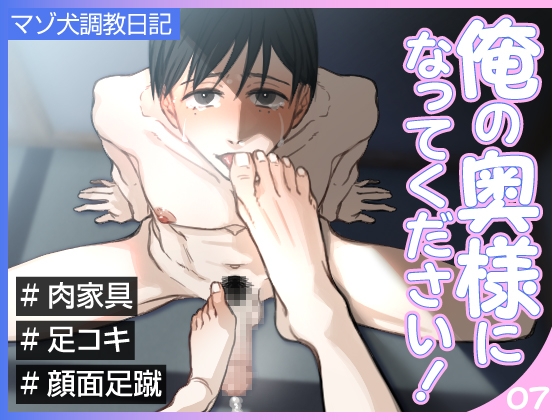
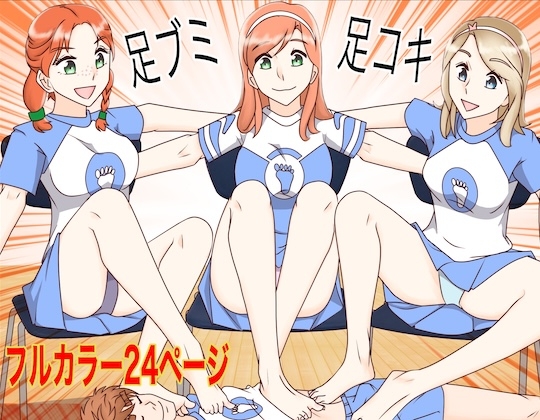
A specific act category within the broader foot-fetish tradition: the use of the feet, often combined with toes, to stimulate the male partner’s genital area. The Japanese AV-and-fictional-content production traditions have stabilised this act-category under the term ashikoki, and the resulting category sits centrally in the broader foot-fetish production ecosystem.
Overview
Ashikoki (Japanese: 足コキ, ashikoki; literal compound: 足 ashi, “foot / leg” + コキ koki, the renyōkei (continuative) form of the verb 扱く koku, “to grasp-and-pull”; English working translation: footjob) is the Japanese industry-and-adult-vocabulary category for the act of stimulating the male partner’s genital area using the feet. The category sits adjacent to and parallel with tekoki (handjob), with the body-part-providing-the-stimulation being the principal point of difference between the two categories.
The act involves contact of the foot, sole, and/or toes against the partner’s genital area, with motion-modes including stroking, sliding, gripping with the toes, and pressing-and-releasing. The act can be performed bare-foot (the body-part itself as the surface providing the act), or wearing stockings (with the stocking-fabric as an intermediate surface), or wearing high-heels or other footwear (with various combinations of toe-tip-only, instep, and shoe-surface contact configurations).
The act sits centrally within the broader foot-fetish production ecosystem and is the principal act-category through which foot-fetish-coded narrative-and-AV content develops. The act’s frequent connection to chijo (dominant-female) production is a recurrent feature of the category, with the standing-female / sitting-or-lying-male postural configuration providing a recognisable active-receptive role-reversal visual register.
Etymology
The compound ashi-koki parallels te-koki (handjob) in construction, with the body-part character (ashi, “foot” / te, “hand”) combined with the same koki element. The verb 扱く (koku) is an older Japanese verb meaning roughly “to grasp tightly and pull” or “to strip”, and the connection between the verb’s literal meaning and the genital-stimulation application establishes the broader pattern that the -koki element follows: the body-part-providing-stimulation combined with a verb-derived suffix denoting the grasping-and-stroking action.
The compound’s adult-vocabulary application stabilised in the 1990s alongside the broader expansion of foot-fetish-themed Japanese AV production. The Japanese-language preference for written-orthography that mixes hiragana, katakana, and kanji (足コキ, with kanji ashi and katakana koki) is a stylistic preference common to industry-vocabulary writings and reflects the broader trend toward visually-distinctive orthography in adult-vocabulary lexicon.
The English-language footjob parallels Japanese ashikoki directly: the English noun foot combined with the slang suffix -job (also seen in handjob, blowjob, and other adult-vocabulary categories). The structural-parallelism between Japanese and English vocabulary in this set of categories is unusually direct relative to other adult-vocabulary translations, and the cross-language category-mapping is unproblematic.
Historical development
Pre-modern foot-aesthetic background
The cultural-historical background of foot-aesthetic interest extends across multiple traditions; the modern adult-content category specifically has more compact origins, beginning to take recognisable form in the 19th-century French and German fetishism-literature lineage (Krafft-Ebing, Ellis, Binet) where foot-fetishism was identified as a frequent fetish-aesthetic-category. The French novelist Nicolas-Edme Rétif de la Bretonne (1734-1806) wrote substantially on his own foot-fetish, and the term retifism derived from his name appears in the 19th-century medical literature as a term for the category.
Sigmund Freud’s Three Essays on the Theory of Sexuality (1905) treated foot-fetish within the broader fetishism framework, and the case-record-and-theoretical-framework lineage from Freud through subsequent psychoanalytic and sex-research traditions has consistently treated foot-fetish as one of the more-frequent fetish-aesthetic categories.
Pre-modern Japanese foot-aesthetic representations
In Japanese pre-modern visual culture, foot-and-leg-aesthetic-attentive depictions appear in shunga (early-modern erotic woodblock prints) by Kitagawa Utamaro, Katsushika Hokusai, and other major woodblock artists. The compositional attention to feet and foot-positioning in these works indicates the established presence of foot-aesthetic recognition in pre-modern Japanese erotic-and-aesthetic vocabulary. The modern Japanese literary tradition includes foot-aesthetic-attentive work in Tanizaki Junichirō’s novels (Shisei / The Tattooer, 1910; Chijin no Ai / A Fool’s Love, 1924-1925; Shunkinshō / A Portrait of Shunkin, 1933), and Tanizaki’s foot-aesthetic descriptions are widely treated as a representative example of foot-aesthetic-recognition in modern Japanese literature.
Establishment of ashikoki as a distinct AV category
The Japanese AV industry’s establishment of ashikoki as a distinct sub-category proceeded through the late-1990s and 2000s, in parallel with the broader establishment of foot-fetish as a distinct production-genre. Specialist labels appeared, and the standard combination with chijo (dominant-female) production produced the recognisable chijo-ashikoki sub-category that has been one of the genre’s most stable production sub-types.
Through the 2000s and 2010s, advances in camera-and-editing technique enabled fine-grained close-up depiction of foot-and-toe motion, stocking-fabric texture, and footwear-detail. The category’s production has substantially elaborated through this technical-development period, and the contemporary form of the genre includes fine-detail visual-aesthetic conventions that the technical platform makes possible.
Sub-categories
Bare-foot ashikoki: the most basic form, with the foot and toe surface as the principal contact-elements. The basic-form variant is one of the more straightforward visual-aesthetic configurations, with the foot’s anatomical detail directly readable as the visual focus.
Stocking ashikoki: with stocking-fabric as an intermediate surface. The combination of skin-tactile-register with fabric-tactile-register produces a doubled-surface configuration that has its own dedicated audience-segment. Sub-divisions by stocking colour and material (black, skin-tone, fishnet) produce further sub-categories.
High-heel ashikoki: with high-heel-footwear configurations. The variant includes the just-removed-shoe configuration, the shoe-still-worn configuration, and combinations of the two within a single scene. The fetish-equipment register of high-heels combines with the foot-fetish register to produce a substantial dedicated sub-genre.
Chijo-ashikoki: the chijo (dominant-female) version, with command-language, mild-disparagement, and edging configurations adding psychological-and-verbal layers to the physical act. The sub-category is structurally distinct from the more-neutral basic-form, with the dominant-receptive role distribution as a defining narrative feature.
POV ashikoki: with the camera positioned in the receiving-partner’s eye-line, the on-screen feet at frame-front. The sub-category emphasises viewer-immersion and stabilised through the 2000s as a stable AV production sub-form.
Cultural and gender-aesthetic context
Cultural-anthropology and psychology literature treats foot-fetish (and ashikoki specifically) as one of the more universal fetish-aesthetic-variants, with substantial presence across cultures and historical periods. The frequency-of-citation in clinical and academic literatures reflects the category’s broad cross-cultural distribution as well as its character as an extensively-documented case-study category.
In gender-aesthetic terms, the ashikoki category has an interesting structural feature: the standing-female / sitting-or-lying-male postural configuration of much ashikoki content reverses the conventional active-receptive postural distribution that characterises much heteronormative sexual depiction, with the female-partner in the active-providing role and the male-partner in the receptive position. The structural-reversal is one of the elements that connects ashikoki to the broader chijo genre and contributes to the chijo-ashikoki sub-category’s recognisability as a distinct production-genre.
Position in international vocabulary
The English-language footjob category has a substantial parallel international production-and-consumption ecosystem, particularly in Anglophone subscription-content and online-foot-content economies. The category translates straightforwardly across language boundaries and has a relatively-coherent international vocabulary, with cross-cultural reception of the Japanese-specific configurations (chijo-ashikoki, the high-heel-and-stocking sub-categories) being relatively-frictionless.
Related Terms
- Foot fetish (ashi-fetish)
- Handjob (tekoki)
- Paizuri (breast stimulation)
- Stockings
- High heels
- Chijo (dominant women)
- Cosplay
- SM Culture
Updated
References
- 『Erotic Comics in Japan: An Introduction to Eromanga』 Amsterdam University Press (2021)
- 『Foot Fetishism: An Introduction』 Routledge (2008)
- 『AV 30-year history』 Bungei Shunjū (2009)
- 『Sexual Fetishism: Pathology and Theory』 Sexual and Marital Therapy (2002)
Also known as
- footjob
- foot job
- ashikoki
- ja: 足コキ
- ja: 足扱き
Related
- Awa-awa Play (Soapland Foam Body-to-Body Service)
- Anal (anal sex)
- Back position (doggy style / rear-entry)
- Double penetration (DP)
- Simultaneous penetration (douji-sounyu)
- Fera (fellatio / blowjob)
- Group sex (fukusū-play)
- Gansha (facial cumshot)
- Irrumatio
- Koneageru (to knead up)
- Foreplay (Zengi)
- Fudeoroshi (Sexual Initiation by an Older Woman)