Cosplay
✎ 本文編集 (admin) 🖼 画像編集 (admin)“Cosplay” works on DLsite



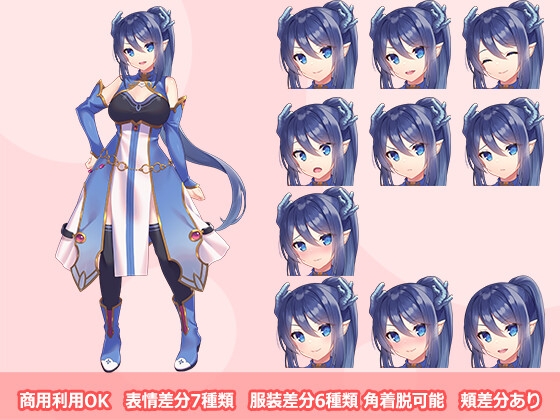
A Japanese coinage that crossed the Pacific, settled in international fan vocabulary, and quietly entered the Oxford English Dictionary. Costume worn as character. Cosplay names the practice, and a wider register of costume-and-role kink in adult media that grew up alongside it.
Overview
Cosplay (Japanese: コスプレ, kosupure) is a Japanese coinage — kosu, from English costume, plus pure, from English play — that denotes the practice of dressing as a fictional character from manga, anime, video games, film, or television. The word and the practice have moved out of Japanese subculture and into international fandom; cosplay is now a recognisable activity at anime and comics conventions worldwide, and the romanised loanword is the standard category label across English, French, German, Mandarin, Korean, and other fandom languages. The Oxford English Dictionary lists cosplay as a headword.
In the adult-media sense, cosplay names the costume-and-role aesthetic that draws on the same costume vocabulary but treats it as the carrier of role-coded sexual interest. Two layers run in parallel: a uniform layer (the maid, the shrine maiden, the nurse, the schoolgirl in sailor uniform, the policewoman, the bunny waitress) and a character-recreation layer (specific characters from specific source works). The two layers overlap in practice but are conceptually distinct, and adult-media production typically treats them differently.
The kink dimension of cosplay is more than costume fetishism narrowly construed. The costume in cosplay is a marker of role — the role-coded uniform of a profession, a class, or a relationship — and the appeal is the role as much as the cloth. A nurse uniform is not just a length of white fabric; it carries an agreed-upon set of social-role meanings (medical authority, the receptive position of the patient, the bedside-care relationship), and cosplay engages those meanings as part of what it does. This is the structural point that distinguishes cosplay from pure costume fetishism.
Etymology
The Japanese coinage kosupure dates to 1984. The editor Nobuyuki Takahashi (Studio Hard), reporting on the costume practices at the 42nd World Science Fiction Convention (L.A.con II) in Anaheim, used the abbreviated form kosupure (costume play) in his Japanese-language coverage of the event. The wasei-eigo abbreviation matched the established Japanese habit of contracting English compounds, and the term spread quickly through Japanese-language SF and anime fan publications.
The English phrase costume play, in its native usage, denotes either historical-drama theatre and film or, more loosely, period costume in performance. The Japanese coinage took the phrase in a different direction: not period drama, but fan-fiction-as-costume. When Anglophone fandom imported the word back, in the late 1990s and early 2000s, it adopted the Japanese sense; the original English phrase costume play did not gain comparable traction, and cosplay as a noun has been the standard. The word entered the Oxford English Dictionary through the 2000s.
History
The 1939 World Science Fiction Convention
The deeper background to convention-floor costuming runs back to the first World Science Fiction Convention, held in New York in July 1939. Forrest J. Ackerman and his partner Myrtle R. Douglas (Morojo) attended in costumes inspired by the 1936 film Things to Come, an event sometimes cited as the founding instance of fan-cultural costuming at a science-fiction convention. The intervening decades saw costuming become a regular feature of Anglophone SF and comics conventions, but it remained a minority practice, framed under the label costume contest rather than as a defining fan activity.
Comic Market and the codification of Japanese cosplay
In Japan, the practice consolidated through the late 1970s and 1980s on the floor of Comic Market and other doujinshi conventions, where attendees increasingly attended in costume of characters from current commercial works. The dedicated magazines Costume Play Comic and COSMODE appeared in the 1990s and supplied the practice with its own publishing infrastructure. Through the same period, areas around the bookshop and doujinshi-shop districts of Ikebukuro in Tokyo and Nipponbashi in Osaka developed as informal photography spots where cosplayers gathered to be photographed in character; these districts have since become recognised landmarks of contemporary Japanese subcultural geography.
Adult-media adoption
In adult media, role-coded uniform costume was a stable element well before the term cosplay arrived. The Nikkatsu Roman Porno series of the 1970s, the contemporary pink-film tradition, and the Japanese AV industry through the 1980s all featured nurse, teacher, secretary, and other professional uniforms as part of their working repertoire. By the 1980s these had hardened into recognised genre categories — uniform-mono, “uniform genre” — within AV.
Through the 1990s, the subcultural label cosplay migrated into the AV industry’s vocabulary, and what had been called uniform-mono was reorganised under the broader cosplay-mono label. The 2000s maid café boom, the rise of fictional-character cosplay among AV performers, and the integration of doujinshi -derived character recreation produced a wider category that combines uniform-coding with fictional-character reference. Cosplay is now one of the principal recurring categories in Japanese AV and adjacent media.
Forms
Uniform / role-coded cosplay
The core of adult-media cosplay. The maid, the nurse, the shrine maiden, the schoolgirl in sailor uniform, the policewoman, the cabin attendant, the teacher: each of these uniforms anchors a distinct role-coded scenario, and the appeal is structurally tied to the role’s social asymmetry — medical relationships, employment relationships, religious roles, age relationships — as much as to the cloth itself.
Character recreation
Direct recreation of specific manga, anime, or game characters. In commercial AV the form usually operates by indirect reference (“X-style” rather than X) to avoid intellectual-property issues with the original rights-holders; in doujinshi circles and fan-photography contexts, the fan-derivative tradition tolerates more direct recreation. The fictional-character layer of cosplay overlaps heavily with the second-creation tradition of doujinshi.
Chakuero and image videos
The chakuero (clothed-erotic) and image-video genres adjacent to cosplay use full costume but stop short of explicit content; they trade on the visual and tactile properties of the costume itself, working in the visible margin between mainstream gravure and explicit AV. Cosplay-themed chakuero is a recognised commercial subgenre that supports a dedicated production sector.
Costume and role-fetishism
In the analytic-psychology tradition, cosplay overlaps with costume fetishism (costume fetishism) and uniform fetishism (uniform fetishism), but with the additional element of the role the costume names. Sigmund Freud’s Fetishism (1927) discussed how particular objects can come to be fixed as sexual symbols through symbolic linkages; clothing — close to the body, removable, half-body half-environment — has long been treated as a particularly available class of such symbols. Cosplay extends this: the costume not only stands in for the body it covers, but indexes a social role in which the wearer can be encountered.
A nurse uniform is not just white cloth. It carries the medical-authority role, the patient-receptive position, the bedside-care relationship; the cosplay of it engages the role as well as the fabric. The role-extension is what distinguishes cosplay from costume fetishism narrowly construed and what makes it overlap with role-play as a wider category.
International diffusion
From the late 1990s, the spread of Japanese anime and manga abroad carried cosplay with it. Anime conventions in North America (Anime Expo, Otakon, Anime Central) increasingly featured cosplay as a defining attendee activity, and around 2000 the older label costume contest was substantially displaced by the Japanese-derived cosplay. The spread continued through the 2000s and 2010s into French, German, Mandarin, Korean, and other fandom communities. Sexual-context cosplay is regionally variable in its visibility — Anglophone fandom tends to keep the line between general cosplay and adult-media cosplay quite firmly, while East Asian fandoms allow more overlap — but the costume vocabulary itself has propagated globally.
Critical reception
The Japanese psychiatrist Tamaki Saitō, in Beautiful Fighting Girl (2000), framed cosplay as a device that blurs the boundary between two-dimensional character and three-dimensional body, allowing fan affection to migrate between them. Hiroki Azuma’s Otaku: Japan’s Database Animals (2001) places cosplay within the wider account of contemporary fan-cultural consumption as a database-driven activity, with the character database functioning as the source of which cosplay is the embodiment. Both treatments have become reference points in the academic literature on cosplay as a cultural practice.
In adult-media production, cosplay has been one of the more durable connections between the wider otaku-cultural sphere and the Japanese sex-content economy. The practice continues to function as a meeting point where character-database consumption, costume fetishism, and role-coded asymmetry converge into a single recognisable form.
See also
Updated
References
- 『cosplay, n.』 Oxford English Dictionary (OED Online) https://www.oed.com/dictionary/cosplay_n
- 『Beautiful Fighting Girl』 University of Minnesota Press (2011)
- 『The Moé Manifesto』 Tuttle Publishing (2014)
- 『Manga! Manga! The World of Japanese Comics』 Kodansha International (1983)
Also known as
- kosupure
- costume play
- character cosplay
- ja: コスプレ
- ja: こすぷれ