“Brassiere (bra)” works on DLsite

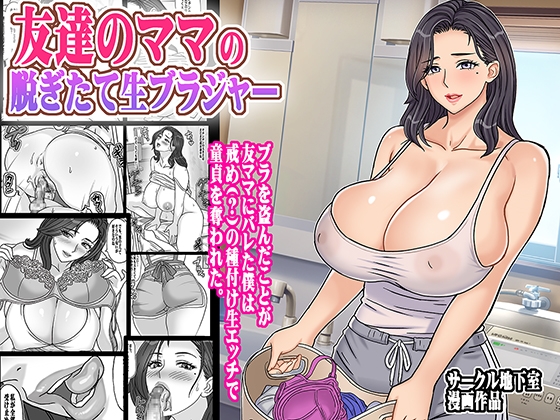
A configuration of cups, straps, hooks, and band, fitted close to the upper body and worn under outer clothing. The Japanese kink-vocabulary identifies the bra as the focus of a distinct underwear-fetish category, and the resulting category sits within the broader lingerie-and-underwear vocabulary at a position with substantial fashion-history and removal-procedure dimensions.
Overview
Brassiere (Japanese: ブラジャー, burajā; abbreviated bra / ブラ, bura; English: brassiere / bra) is the upper-body undergarment supporting and covering the breasts. The modern form was established in the early 20th century and has become, through 20th-century fabric-and-construction development and sizing-standardisation, the central garment category in the contemporary female-underwear system.
In the kink-aesthetic register, the bra’s eroticisation operates through three structural mechanisms: the implicit underneath-something premise (“there’s a bra under the outer clothing”), the procedural-cadence of unhook-and-remove (“it doesn’t come off in one motion”), and the shift / displace possibility (“the bra doesn’t have to be removed; it can be moved aside”).
Distinction from Western framing
The Western brassiere / bra category is the standard female-undergarment-and-fashion-element across global Western fashion. The kink-aesthetic register of the bra in Western contexts tends to operate within the broader lingerie category or within general underwear-aesthetic interest.
The Japanese vocabulary maintains a more distinctly-articulated underwear-fetish sub-categorisation, with bra, striped-panty (shimapan), stocking, garter-belt, and similar each operating as distinct sub-categories with their own production traditions. Within this sub-categorisation, the bra operates with particular attention to the unhook-and-removal procedural-aesthetic that Japanese adult-content production has elaborated extensively as a scene-element.
Etymology
The English brassiere derives from the French brassière, originally an infant’s bodice or arm-garment. The Vogue magazine’s use of the term in 1907 to refer to a women’s chest-support garment is one of the earliest documented English-language uses in the modern sense. The shortened form bra stabilised in casual English use through the mid-20th century.
The Japanese loanword burajā (ブラジャー) entered Japanese-language vocabulary through the broader integration of Western undergarment terminology, with the abbreviated form bura (ブラ) operating as the casual register. The pre-loanword Japanese terms chichi-bando (乳バンド, “breast-band”) and muna-ate (胸当て, “chest-cover”) represent Meiji-and-Taishō-period translation attempts but have not survived in contemporary use.
Structural development
Origins and competing patents
The modern bra’s origins involve multiple competing claims. In the United States, Mary Phelps Jacob (pen-name Caresse Crosby) obtained a 1914 patent (U.S. Patent 1,115,674) for a “Backless Brassiere” constructed from two handkerchiefs and a length of cord. In Germany, women’s-undergarment design from the 1880s onward had developed comparable forms. In France, Herminie Cadolle’s 1889 “Le Bien-être” presented a separated-upper-and-lower corset design.
The 1920s art-deco-period shift from corset-based body-shaping to bra-plus-girdle separated-support marked the structural-transition to the modern bra. The bra emerged as the dedicated breast-support garment, with the lower body covered separately by girdles or panties.
Cup-sizing
Cup-sizing as a standardised system originated in the 1930s United States, with Warner Brothers Corset Company (now Warnaco) introducing the A-B-C-D four-level cup-classification. The system propagated through American and broader international markets and was adopted in Japan from the 1950s onward. The contemporary Japanese sizing notation combines under-bust band-size with cup-letter (e.g. 65B, 70C), with the band-size in centimetres and the cup-letter following the international convention.
Variant proliferation
Contemporary bras have proliferated into numerous functional-and-aesthetic variants. Full cup, half cup, bralette, push-up, minimiser, sports bra, maternity / nursing bra, wireless bra, adhesive bra, strapless bra, and similar each occupy distinct functional-and-aesthetic positions. Materials range across lace, satin, cotton, and sports-functional-textile, with different combinations supporting different priorities of coverage, decoration, and function.
The standard hook-and-eye closure is placed at the back, with the alternative front-closure configuration available. The latter offers easier on-and-off operation and a central-positioning effect on the breasts. The eroticised register of “the front-closure bra comes off in one motion” circulates as a recognisable framing, though the actual primary functional purpose of front-closure is accessibility for users with shoulder or arm limitations.
Structure of the kink-aesthetic
The bra-as-erotic-object operates through structural logic distinct from generic undergarment-eroticisation.
Under-the-outer-clothing premise. The bra is, by structural-position, not directly visible from outside. Its existence is signaled through indirect cues: visible strap-outline, lace-edge appearing at the collar, line-of-the-band visible through tight clothing. The indirect-signaling is itself a substantial part of the erotic engagement-mechanism, supplying imagination with raw material rather than direct visual access.
Procedural-cadence of removal. Removing a bra requires multiple distinct actions: release the back hook (or front hook), slip the strap off one shoulder, slip the strap off the other shoulder, and finally remove the garment from the body. The procedural-cadence introduces a time-dimension to the removal-act. The frequent emphasis in AV and eromanga on “the moment of unhooking the bra” reflects this procedural-element: the unhooking-action operates as a distinct ritual-and-recognised-moment, separate from the broader undressing.
Displacement-without-removal. Complete removal is not the only configuration. The cup can be pulled down to expose the breast while the band remains in place; a single strap can be slipped down while the other remains; the bra can be partially-positioned in ways that combine exposure-and-concealment. The half-on configuration produces an exposure-contrast that fully-naked configurations do not, and is a recognised compositional configuration in adult-content production. The configuration is one of the principal motifs in chakuero (costume-and-erotic) production.
Glimpse-and-see-through aesthetic
The relationship between the bra and the outer garment is itself a substantive object of kink-aesthetic interest. Glimpse-into-the-chest (the bra-top visible through an open neckline), see-through-the-fabric (the bra visible through a thin or light-coloured outer garment), bra-visible-when-bending (the bra and hook visible when the wearer leans forward), and sweat-or-water-revealed configurations each operate as distinct visual-and-erotic configurations. These configurations privilege the “shouldn’t-be-visible-but-is” register over explicit-undress configurations.
The kink-population for whom the partly-clothed-bra-only configuration carries stronger aesthetic-effect than the fully-naked configuration parallels the comparable populations for T-back, striped-panty, and other “fabric-present” configurations: the structural-mechanism is the contrast-of-fabric-with-exposed-skin.
Size and shape preferences
Bra-specific sub-aesthetic preferences include size-and-shape registers. The substantial-presence of full-cup bras supporting large breasts (kyonyū) operates as its own aesthetic. The small-bralette configurations supporting small breasts (binyū) operate as a separate aesthetic. The geometric-emphasis of push-up bras, the functional-aesthetic of sports bras (interesting paradoxically as a kink-aesthetic, the functional-beauty fetish), each occupy their own niche.
Colour-and-material combinations carry stylised semantic load: white for innocence-and-cleanness, black for decadent-and-mature, pink for cute-and-girlish, lace-and-translucent for see-through-and-sophisticated. The frequent depiction in adult-content of matching-set upper-and-lower underwear (matching bra-and-panty) reads as the character’s deliberate-preparation (“she came planning to be seen”), while non-matching configurations read as everyday-realism.
Related Terms
Updated
References
- 『Uplift: The Bra in America』 University of Pennsylvania Press (2002)
- 『The Bra Book: The Fashion Guide to Bras』 BenBella Books (2009)
- 『Sex and Suits』 Knopf (1994)
- 『Bound Up: A History of the Brassiere』 David & Charles (2004)
Also known as
- brassiere
- bra
- breast support
- ja: ブラジャー
- ja: ブラ
- ja: 乳バンド