Long-hair kink
✎ 本文編集 (admin) 🖼 画像編集 (admin)“Long-hair kink” works on DLsite
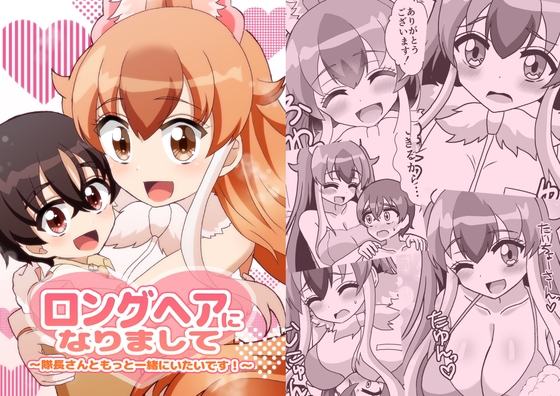
A hairstyle that grows only with time — a centimetre or so per month — and that, at hip length, represents at least six years of unbroken maintenance. The kink-vocabulary’s attention to long hair is, in part, an attention to that time-accumulation itself.
Overview
Long-hair kink (Japanese: ロングヘア, rongu-hea; English: long hair fetish, long straight hair preference) is the kink configuration in which hair grown well below the shoulder — often to the waist or beyond — is treated as a primary aesthetic and sexual focus, separately from any broader hair kink (kami-fetish) preference. The kink is widely attested across world cultures; the Japanese variant carries a distinctive reading attached to the kurogami-long (黒髪ロング, “black long hair”) configuration, in which long black straight hair is read as a sign of classical purity and traditional Japanese femininity. That reading is the entry’s central subject.
The Japanese vocabulary subdivides hair length into semi-long (semi-long, shoulder to collarbone), long (chest-length), and super-long (waist to hip and below). The kink-vocabulary’s attention is concentrated on the long and super-long range. The category is documented across Heian-court literature, late-Edo ukiyo-e and shunga, and modern adult media as one of the most stable Japanese hair-aesthetic categories.
Etymology and definition
The English long hair and the Japanese loanword rongu-hea are both general descriptors without strict length criteria. Practical convention treats hair as long when it extends past the shoulder to chest level, as super-long when it reaches the waist, and as exceptionally long when it extends to the hip or below. The biological growth rate (approximately 1 to 1.5 cm per month) makes long hair a material record of time: hip-length hair represents at minimum five to six years of uninterrupted growth, and the kink-vocabulary often treats this time-accumulation as part of the form’s aesthetic charge.
Cross-cultural background
Long hair has functioned as a marker of feminine beauty across a wide range of cultures. Ancient Greek and Roman sculpture and wall-painting depict long hair as the standard female aesthetic, with the marriage ritual transition to the up-pinned coiffure marking the entry into married status. Ancient and classical Hindu culture attaches multi-layered religious, sexual, and marital meaning to a woman’s long hair: the bride’s plaited hair, the widow’s cutting of the hair following the husband’s death, and the religious-pilgrimage shaved-head offering each carry distinct social meanings, with length functioning as the medium across all of them.
Medieval Christian Europe treated long female hair as the ambivalent sign of both glory and temptation. 1 Corinthians 11:15 (“if a woman has long hair, it is a glory to her”) sits alongside the European convention of veiling married women in public. The iconography of Mary Magdalene’s hair, the Rapunzel folktale, and the Lady Godiva story all engage the same ambivalence: long hair as the simultaneous sign of sanctity and of sensuality.
In Japan, the long-hair tradition has an unusual depth. Heian-period (794–1185) court convention prized the suihatsu (垂髪, “hanging hair”) of noblewomen, in which uncut hair fell loose down the back, in many cases exceeding the wearer’s own height. The Tale of Genji and other Heian-period literature thematise hair length and lustre as central indices of beauty, and the Heian-period aesthetic established the long-black-hair association that has persisted into modern Japanese hair-aesthetic vocabulary. The Edo-period merchant culture maintained the association in a different costume context, and the modern Japanese hair-aesthetic vocabulary — particularly the kurogami-long configuration — descends from this long lineage.
The post-Meiji Westernisation of Japanese hairstyle did not erase the long-hair association. Modern Japanese popular media has continued to deploy the kurogami-long configuration as the standard visual code for the traditional-purity female character archetype, both in eromanga and in commercial adult video.
The kink’s structural elements
Five structural elements together compose the long-hair kink’s appeal.
Flow and volume. Hip-length hair moves in distinct rhythms in response to body motion: walking, turning, leaning, lying down. The kink-vocabulary reads this dynamic motion as a continuous visual stream that shorter hair cannot generate. Animation, with its frame-by-frame attention to motion, has been particularly suited to rendering the dynamic-motion element.
Cover and reveal. Hair extending to the chest or below covers parts of the body when fall and shifts at body movement. The boundary between body and hair becomes mutable, and the dynamic between coverage and exposure is itself part of the visual register. The pose of a long-haired figure lying in bed, with hair fanned across the pillow, has functioned as a recognised aesthetic configuration since the Heian period.
Touch and scent. Long hair supports sustained physical interaction: stroking, combing, lifting, smelling. Short hair completes these acts in seconds; long hair allows them to extend through tens of seconds or minutes. The combination with smell-kink (nioi-fetish) is structurally significant: the scent of long hair, often combined with the residual scent of shampoo, is a recurring kink-vocabulary attention point.
Traditional-beauty signalling. In Japanese cultural reading, long black hair is the visual code for traditional female beauty rooted in the Heian-court lineage. The combination with the kimono — the kurogami-long + kimono configuration — operates as a near-universal Japanese visual code for traditional-femininity in adult and non-adult media alike. The combination with the miko (shrine maiden) costume is a related sub-category.
Power-and-restraint affordance. Long hair is graspable: it can be held, pulled, gathered. In SM-and-power-related kink configurations, the long hair is the standard physical contact-point that allows direct partner control without touching skin. Across the broader kink-vocabulary, this affordance is one of the long-hair form’s structural-aesthetic functions.
Variants
The kink-vocabulary distinguishes several stylistic variants by colour and styling.
Kurogami-long (黒髪ロング, “black long hair”) is the canonical Japanese form, with the strongest traditional-purity reading.
Tea/chestnut long (茶髪・栗色ロング), modern Japanese hair-colour conventions, with a more contemporary and approachable reading.
Blonde long, with Western-exotic associations.
Long waves, with the corkscrew or wave-form motion-aesthetic.
Princess cut (お姫様カット), with shorter front side-locks framing the face and the bulk of hair falling long behind.
Plaited long, with a single three-strand braid down the back, carrying a purity-and-religious reading.
Bed-head long (寝起き乱れ髪), with the styled-aesthetic temporarily set aside in private contexts.
Wet long, with the styling temporarily collapsed by water and the hair clumped into wet strands.
Miko-style long, the white-and-red shrine-maiden costume’s long hair.
Anime-long, the exaggerated lengths of anime character design, often impossibly long and not modelled on any real-world hair-physics constraint.
Cultural reception
In Japanese commercial adult media, kurogami-long and kurogami-long-straight are among the most frequently used title-keyword elements. The title-line structure “seiso na mikake to ura-hara no…” (“with a chastity-suggesting exterior but in fact…” [contrary action]) presupposes the kurogami-long configuration as the costume-aesthetic anchor for the chastity-suggesting exterior. AV performer casting, package design, and promotional photography all treat the maintenance of long hair as a commercially-relevant element.
In 2D media — doujinshi, eromanga, eroge, hentai anime — the long-hair archetype attaches to specific character-types: the orthodox-heroine, the ojou-sama (well-bred young lady), the miko, and the older calm female character. The combinations kurogami-long + kimono, blonde-long + dress, and silver-long + sailor uniform have stable signified-meanings (traditional-Japanese, fantasy-aristocrat, cool-mysterious respectively) within the broader visual-vocabulary of Japanese subculture.
Internationally, the cultural-history of long hair as a female-beauty marker has varied substantially. The Western 1960s short-hair and bob-hair movements (associated with the second-wave feminist critique of long hair as a sign of feminine submission) interrupted the long-hair tradition in much of the Western world. By contrast, East Asian, South Asian, and Middle Eastern cultures have largely maintained the traditional long-hair beauty-aesthetic into the contemporary period. The kink-vocabulary’s persistence in Japanese adult-media culture sits within this broader East Asian continuity.
Cosplay culture has made the long-hair wig a recognised costume element, with extensions and full wigs available in lengths exceeding any practical natural hair length. The wig’s reproduction of an anime character’s exaggerated long hair is one of the standard tests of cosplay-costume completeness.
Related Terms
- Hair kink (kami-fetish) — broader umbrella
- Short hair kink — opposing aesthetic
- Bob hair fetish — intermediate-length aesthetic
- Twintails — bound-long variant
- Ponytail kink — bound-long variant
- Kimono — paired traditional costume
- Miko (shrine maiden) — paired traditional costume
- Cosplay (kosupure) — wig culture
Updated
References
- 『Hair: Its Power and Meaning in Asian Cultures』 State University of New York Press (1998)
- 『Hair: A Human History』 Pegasus Books (2016)
- 『The Tale of Genji』 Viking (2001) — Original c. 1008; Heian-court hair aesthetics treated throughout.
- 『髪と日本人』 Heibonsha (1988)
Also known as
- long hair fetish
- long straight hair preference
- hair worship (long-hair)
- black long hair aesthetic
- kurogami long
- ja: ロングヘア
- ja: 黒髪ロング
- ja: ロングストレート
- ja: 長髪