Business Suit Fetish
✎ 本文編集 (admin) 🖼 画像編集 (admin)“Business Suit Fetish” works on DLsite
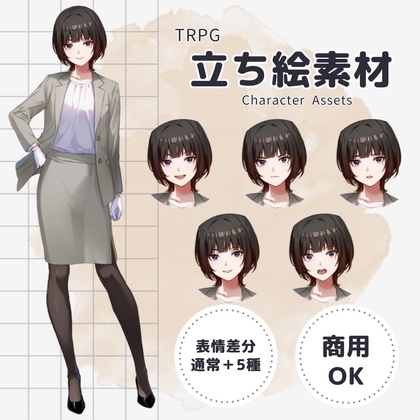
The Japanese category of suit fetish takes a particular form: the office-lady silhouette, the recruit-suit uniformity, the secretary archetype. The structural ideal is the contrast between the workplace’s composed surface and the more private register beneath it.
Overview
Suit fetish (Japanese: スーツフェチ, sūtsu fetchi) names the taste for women in business-suit dress — tailored jacket and skirt (or trousers), blouse, stockings, pumps — as an erotic object. The Japanese version of the category is bound up with the social images of the OL (office lady), the secretary, and the female career professional, and forms a distinctive sub-domain of clothing fetishism with a clear Japan-specific cast.
Etymology and scope
Suit derives from French suite, with the original sense of a matching set. The narrow business suit is the tailored jacket and matching skirt or trousers, worn with a collared blouse. In postwar Japan, the suit became the standard professional dress for office-working women from the period of rapid economic growth onward; by the 1980s it had been encoded as the OL fashion and recruit suit signifiers, and the suit acquired a settled social-symbolic meaning that the fetish category subsequently took up.
What the fetish targets is less the garment itself than what the garment signifies: workplace professionalism, the public composed presence, the discipline of the office, the contrast between the composed surface and what becomes visible when that surface is loosened.
History
The historical origin of the women’s business suit traces to 1890s Britain, where tailor-made women’s suits were the first applications of men’s tailoring techniques to women’s wear: jacket and matching skirt as a two-piece set. In Japan, women’s office work expanded sharply through the postwar period, and the suit moved with it. The label OL (office lady) was the product of a 1963 women’s weekly-magazine reader vote; the 1986 Equal Employment Opportunity Law accelerated the expansion of women into career-track (sōgōshoku) positions, and tailored suits modeled on men’s business dress entered general use.
The recruit suit (rikurūto sūtsu) is a Japan-specific category. It refers to the standardised suit worn during Japanese job-hunting (shūkatsu), restricted by convention to navy, black, or dark grey, with deliberately understated cut and styling. The conformity is itself the point: the suit signals candidate eligibility for a corporate role precisely by erasing personal style. That structural anonymity has become a fetish-relevant feature in its own right.
Components of the fetish
The Japanese version of suit fetish is built on four layered elements.
Tailoring and silhouette
The tailored jacket structures the shoulder-to-hip line; the tight skirt encodes the hip-to-knee curve through a constraining geometry rather than direct exposure. The result is that the body is fully covered and the bodyline is nevertheless sharply legible, which connects the fetish to the wider Japanese chakui (dressed-play) tradition.
Vocational authority
The suit signals a woman who works, a woman with responsibility, a public role. The structural contrast between this public composure and the private register beneath it is the central narrative axis of the fetish. The fetish material returns repeatedly to the moment at which the public register is loosened — the unbuttoning, the slight disarrangement.
Leg architecture
Between the hem of the tight skirt and the pumps, a continuous line of beige, black, or grey stocking connects knee to ankle. The whole structure of the leg, from knee to foot, becomes one visual unit, with the suit-and-hosiery combination as its supporting structure.
Graduated unfastening
The disassembly sequence — jacket off, blouse buttons opened, skirt slid up, hose pulled down — defines a fixed set of escalating visual moments. The fully composed state, the partial states, and the fully undressed state are all named separately, with the partial states sometimes treated as the most-valued objects of the fetish.
Subcategories
- Recruit suit: the job-hunting standard suit; young, novice, candidate identity.
- OL suit: working office lady; routine deskwork, telephone, copy-room settings.
- Secretary suit: tighter, knowing, with the boss-secretary power register.
- Career woman suit: senior manager, often the older woman with a younger man as romantic counterpart.
- Pantsuit: trousers rather than skirt; boyish mode mixed with the suit’s vocational signal.
- Workplace uniform suit: bank, airline, department-store standardised company uniforms (seifuku overlap).
In adult media
Adult-media work has long treated OL, secretary, boss, and subordinate productions as a stable category. From the 1990s onward, this category has combined with the wider OL genre, with chakuero (clothed-erotic) work, with chikan (groping) scenarios, and with workplace power-dynamic settings. The conventions of acting on her while she stays in the suit, running the stocking without taking it off, pulling up the skirt without removing it have become a near-fixed visual rule-set.
In two-dimensional work (manga and animation), the suit operates as a character-type signifier: the female superior, the secretary character, the career-oriented colleague. The glasses + suit + tied hair combination is one of the most consistent visual codes for intelligent, professional, restrained female character types, and is routinely combined with megane (glasses) and hair fetishism.
International comparison
Business suit fetish exists as an established kink category in Western (Anglophone, European) fetish culture, but the Japanese form has taken a particular shape that the wider international category does not closely mirror. Western power dressing tends to frame the fetish around the senior female manager and her authority — the boss in the corner office register. The Japanese form, by contrast, places much of its weight on the standardised uniform of office work: the recruit suit, the OL suit, the workplace-uniform suit. The Japanese version reads the suit’s collective-conformity dimension as much as its individual-authority dimension.
This is a recognisable expression of the Japanese postwar history of women’s office work, in which the suit’s symbolic charge has been shaped by the structure of the corporate workplace and the OL category more than by a Western executive woman archetype.
See also
Updated
References
- 『Sex and Suits』 Knopf (1994) — Standard reference on the cultural history of the suit as a Western garment.
- 『OL no Shakaishi』 Keiso Shobo (2000) — Postwar Japanese women's office-work history and clothing standards.
- 『Fashion-ology』 Berg (2005)
- 『Jenrubetsu AV Taizen』 Core Magazine (2014)
Also known as
- suit fetish
- business suit fetish
- office lady (OL) suit fetish
- recruit suit fetish
- ja: スーツフェチ
- ja: OLスーツ