Nobura (braless)
✎ 本文編集 (admin) 🖼 画像編集 (admin)“Nobura (braless)” works on DLsite
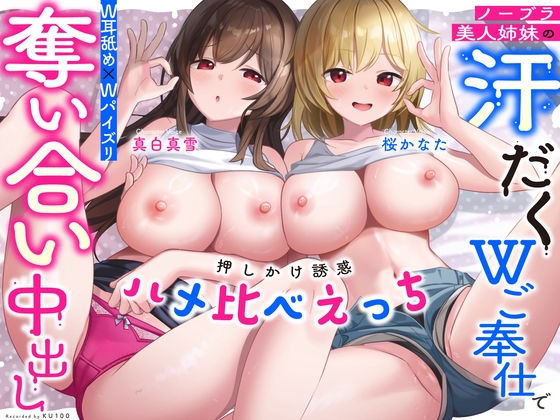
A white T-shirt in evening light. Two small shadows where the fabric drapes against the body. The cool of an air-conditioned room, or some shift of the wearer’s attention, sharpens the outline. The viewer cannot tell whether she has noticed, or whether she has noticed and is pretending not to. Nobura is the Japanese-and-international aesthetic-category for the braless-under-clothing state, and the form has accumulated substantial production-and-aesthetic vocabulary across the broader chakuero (clothed-erotica) tradition.
Overview
Nobura (Japanese: ノーブラ, nōbura; English working translations: no-bra, braless, braless-under-clothing) is the Japanese aesthetic-category for the state in which a female-presented body wears outer-clothing without an underlying bra. The form is one of the most-developed sub-categories within the broader chakuero (clothed-erotica) tradition: where standard clothed-erotica works with the visibility-of-clothed-bodies more broadly, the nobura register specifically foregrounds the visibility-of-the-breast-through-clothing that the absence-of-underlying-bra produces.
The compound term nobura is built from the English no and the Japanese loanword bra (the abbreviation of brassiere). The compound is a wasei-eigo (Japanese-coined English) construction, with the corresponding English-language term being braless or going braless. The Japanese-and-international fan-vocabulary uses nobura as the dedicated category-term for the corresponding aesthetic-and-erotic-register, with the broader English braless operating in less-specifically-aesthetic-coded contexts.
The form operates across multiple distinct contexts: private-and-domestic (the room-clothing context where the absence-of-bra is functional rather than display-oriented); deliberate-and-public (the choice-to-go-braless in public-context as fashion-or-statement); occasional-natural (sleepwear, athletic-context, particular-clothing-choices); production-coded (the corresponding aesthetic-and-content-production tradition that has elaborated the form into a recognisable independent category).
History
1960s American feminist context
The cultural-historical anchor for the contemporary nobura aesthetic is the late-1960s American feminist movement, particularly the bra-burning moment of 1968 (the Miss America protest at Atlantic City). The actual-bra-burning of that protest was largely metaphorical — the protesters did burn objects, but the brassieres-specifically were not, by most accounts, actually burned — but the bra-burning image circulated as a powerful cultural-rhetorical figure for the broader argument that the brassiere represented a mode of physical-restraint-and-display-discipline imposed on the female body.
The corresponding aesthetic-and-political position — the brassiere as an item of constraint-imposed-on-the-female-body, with the corresponding braless state as a position of liberation — became one of the period’s recurring rhetorical figures. The fashion-industry response in the late-1960s and early-1970s was substantial: the no-bra look became a fashion-position, with several designers producing collections specifically built around the look, and the corresponding cultural-acceptance-of-the-braless-state expanded substantially in those years.
The political-and-fashion register of braless in this period was not simply an erotic-aesthetic; it was a political-and-aesthetic position with the corresponding cultural-debate. The contemporary nobura aesthetic inherits substantially from this period, with the politics-and-fashion-register continuing to inform the form’s reading-context.
1970s and 1980s Japan: bodikon and the see-through register
In Japan, the contemporary nobura aesthetic-position consolidated through the 1970s and 1980s, in parallel with the bodikon (body-conscious) fashion of the late-1980s and the piti-T (tight-T-shirt) fashion of the broader period. The corresponding thin-fabric-revealing-body-shape aesthetic — particularly the braless-under-tight-fabric configuration — became established as a recognised fashion-and-erotic register.
Through this period the form developed a dual character. The political-feminist register continued to operate; the aesthetic-and-fashion register operated in parallel. The two registers coexisted, and the form’s reception-context drew on both: the political-register provided the liberation-from-restraint reading, the aesthetic-register provided the body-form-visible-through-fabric reading. The contemporary nobura aesthetic has retained both registers, with the corresponding readings operating in tension-or-combination depending on the specific context.
2000s onward: digital production and category-codification
In the digital-content era from the 2000s onward, the nobura aesthetic has consolidated as a recognised independent production-and-distribution category. Adult-content production with the nobura-themed or nobura-coded register has become a stable sub-category of the broader chakuero (clothed-erotica) production. Online vocabularies, fan-tag systems, and content-distribution platforms maintain the corresponding category-recognition.
The 2020s have brought a health-and-comfort register to the form’s broader reception-context. The sleeping-without-bra, home-relaxation-without-bra, and stress-free-no-bra registers — driven by health-and-comfort-marketing campaigns from manufacturers of the corresponding products — have expanded the form’s reception-context beyond the more-specifically-erotic register into a broader life-style-choice register. The corresponding not-only-erotic reception-register is one of the more-recent developments in the form’s broader cultural-position.
Visual signs and forms
The nobura register operates with several recognisable visual-signal-elements that the form’s reception-vocabulary has codified.
Visible-nipple-mark (pochi, ポチ, the outline-of-nipple-through-thin-fabric). The visible mark of the nipple’s pressure-against-the-fabric, particularly under conditions where the temperature, attention, or other-stimulation produces the corresponding skin-response. The pochi register is one of the form’s most-developed-and-codified sub-aesthetics, with the corresponding production-and-reception conventions for handling the visual-element. The Japanese nipple-mark register has its own independent vocabulary: nippuru-pochi (nipple-pochi), and the broader range of related-vocabulary.
Bounce-and-movement (the breast-shape’s movement under fabric without the bra’s containing-and-controlling structure). Walking, running, climbing-stairs, jumping, and other body-movement contexts produce the corresponding bounce-and-movement-of-breast-shape that the absence-of-bra makes visible. The corresponding bounce-aesthetic is part of the form’s reading-and-reception register.
Through-fabric outline. Damp-fabric, thin-white-fabric, loose-knit-fabric, and other partial-transparency-conditions produce the corresponding visibility-of-breast-shape through the clothing. Shower-after, rain-soaked, swimming-pool-aftermath, and similar contexts foreground the through-fabric-visibility of the breast-shape. This sub-register is the principal one engaged-with by the wet-T-shirt tradition in international vocabulary.
Bra-strap-absence. In tank-top-or-camisole clothing, the standard bra-strap arrangement would be visible at the shoulder; the absence of the bra-strap is a visible-and-codable element that the corresponding observer reads as a strong-signal of the corresponding state. The bra-strap-absence is one of the minimal-and-recognisable signs of the nobura state.
Reception register
Awareness-axis: aware vs. unaware
The nobura register sub-divides on a key axis: whether the body-bearer is aware-of-the-state-and-its-visibility or unaware-of-the-state-and-its-visibility. The two sub-registers produce structurally-different reading-and-aesthetic-effects.
The aware-and-deliberate sub-register operates in display-oriented contexts: chakuero production, gravure photography, influencer-erotica, and the broader display-oriented-content-production tradition. The body-bearer is choosing-to-go-braless and is aware of the visibility-implications, and the corresponding reading-register foregrounds the body-bearer’s-choice-and-self-presentation.
The unaware-and-natural sub-register operates in narrative-fiction contexts: home-clothing-narrative scenes, intrusion-fiction (witnessed-by-third-party scenarios), surveillance-coded fiction, and similar narrative-frames. The body-bearer is in the nobura state for ordinary-life-reasons and is not-foregrounding the visibility-implications; the reading-register foregrounds the observer-of-the-state position rather than the body-bearer’s choice.
The two sub-registers are roughly-complementary: many works use both at different points in their narrative arc, with the unaware-register operating in one scene and the aware-register operating in another.
Combination with nopan (no-underwear)
The nobura state is often paired with the nopan (no-underwear) state in production conventions. The nopan-and-nobura at home configuration, the nopan-and-nobura-in-T-shirt-only configuration, the nopan-and-nobura-under-summer-wear configuration are recognised production-templates that combine the two related-and-paired underwear-absent configurations.
The combination produces a fully-underwear-absent-but-outer-clothing-present structural-configuration: a partial-undressing rather than a complete-undressing, with the outer-clothing-as-sole-coverage register. The configuration is structurally-distinct from full-nudity, operating in a register where the outer-clothing-as-final-barrier remains in place, and where the imagining-the-removal-of-the-final-layer reading-engagement is structurally-supported.
Legal and social context
In Japanese law, the nobura state in public is not, by itself, an offense under Article 175 (the obscenity statute) of the Penal Code or under the closely-related public-decency statutes. The corresponding social-and-cultural-evaluation of the state varies with context: in private-and-domestic contexts the state is culturally-acceptable; in public contexts the cultural-evaluation depends on the specific clothing-and-context-configuration, with thin-fabric-and-extreme-visibility-conditions producing more-significant social-attention than thicker-fabric-and-less-visibility-conditions.
The Misdemeanour Penal Act (keihanzai-hō) provides for a public-indecency offense for exposing-of-the-body in public contexts; whether a particular nobura configuration would meet the corresponding threshold has been a topic of occasional commentary, with the corresponding analysis depending on the specific configuration. In standard practice, prosecution under the corresponding statute for nobura-configurations in standard everyday-clothing-contexts is rare, and the social-and-cultural-evaluation of the corresponding configuration is the more-active register than the legal-prosecution register.
Note on the wider field
The nobura register operates as one of the most-developed independent sub-categories within the broader chakuero (clothed-erotica) tradition. The corresponding aesthetic-and-erotic register’s structural reliance on the partial-visibility and imagining-of-what-fabric-conceals aesthetic places it in close-relation to the broader clothed-erotica vocabulary, with the specifically-bra-absent register as its independent category-marker.
The form’s reception across multiple cultural-and-political registers — feminist-political register, fashion-aesthetic register, erotic-aesthetic register, health-and-comfort register — is part of what makes it a particularly informative case-study of how a clothing-and-body configuration can carry multiple-readings simultaneously. The corresponding multi-register character is part of the form’s continuing place in cultural-discussion, both within the dedicated fan-and-production communities and in the broader cultural-and-fashion vocabulary.
Related Terms
- Nopan (no underwear)
- Lingerie fetish
- Panchira (under-skirt glimpse)
- Chakuero (clothed-erotica)
- Gravure
- Public exposure (roshutsu)
- Bodikon (body-conscious fashion)
Updated
References
- 『Bra: A Thousand Years of Style, Support and Seduction』 David & Charles (2004)
- 『Uplift: The Bra in America』 University of Pennsylvania Press (2002)
- 『The Body Project: An Intimate History of American Girls』 Random House (1997)
- 『Erotic Comics in Japan: An Introduction to Eromanga』 Amsterdam University Press (2021)
Also known as
- no-bra
- braless (J-AV context)
- braless
- nobura
- ja: ノーブラ
- ja: ノーブラジャー
- ja: ブラなし