Panchira
✎ 本文編集 (admin) 🖼 画像編集 (admin)“Panchira” works on DLsite
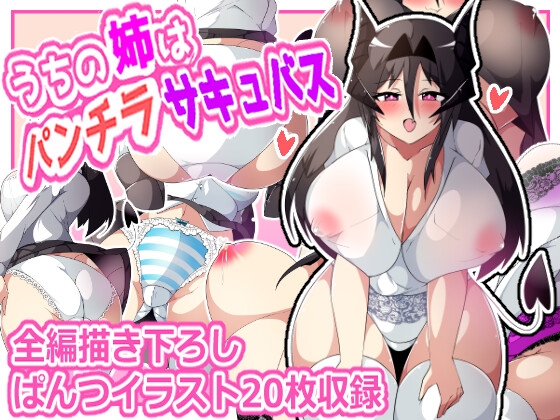
A staircase, a gust of wind, a moment of bending. The glance that catches a flash of cloth and is gone before recognition. Panchira names that moment, and Japanese drawn media has spent half a century working it into one of the most recognisable conventions of its visual grammar.
Overview
Panchira (Japanese: パンチラ, panchira) is the Japanese-language term for a brief, partial visibility of underwear from beneath a skirt or short garment. The compound is a wasei-eigo coinage from pantsu (the Japanese loanword for women’s underwear) and chira (the Japanese onomatopoeic stem for a glimpse, a flicker, a brief sighting). The term has functioned as a recognised stock convention in postwar Japanese manga, anime, and live-action visual representation since the late 1970s.
Two formal features mark the convention. First, the visibility is partial: not the full underwear, but a fragment of it, briefly visible. Second, the visibility is treated within the fiction as contingent — the wearer is presumed not to have intended it, and the viewer is positioned to catch it before the moment passes. The contingency framing is the structural feature that distinguishes panchira from deliberate self-display (roshutsu, exhibitionist exposure) and that gives the convention its specific iconographic register.
The genre operates in a deliberately narrow visual register. The panchira moment is typically held for a single panel in manga, a single frame or two in animation, a single still in photography. Across each of these media, the convention has produced a stock vocabulary of stage directions: stairs from below, gust of wind, leaning over to pick up a fallen object, sitting and crossing legs, riding a bicycle. The vocabulary is well enough established that audiences recognise the stage direction as soon as it begins.
A note about the legal frame in which the genre operates: in Japan, photographing real people’s underwear without their knowledge or consent — the so-called upskirt photography — is criminalised under prefectural nuisance ordinances and, since 2023, under a national photographic-sexual-offence statute. This article describes the fictional and consensual-photographic conventions of panchira as a Japanese visual genre; it is not a description of and does not endorse non-consensual photography of real persons.
Etymology
Panchira is a postwar Japanese coinage. Pantsu (パンツ) is the loanword from English pants, used in Japanese specifically for underwear (the Japanese-internal term for trousers is zubon, also a loanword but from French). Chira is the onomatopoeic stem from a small family of Japanese words for momentary visibility — chiratto (“at a glance”), chirari to (“flickeringly”). The compound pantsu chirari contracts to pan-chira through standard Japanese phonological reduction.
The term entered general magazine and manga vocabulary through the 1970s and 1980s and was current in standard Japanese dictionaries by the 1990s. In English-language contexts, the descriptive equivalents panty shot and upskirt are in use; panchira itself circulates as a loanword in Anglophone anime and manga fan communities, where the Japanese-cultural specificity of the convention makes the loanword preferable.
History
Pre-1960s background
Stock images of underwear briefly visible under a hem can be traced in Japanese popular print to the prewar erotic-magazine tradition, but the form did not consolidate as a standardised visual convention in the modern sense until the postwar period. The decisive enabling shift was the Westernisation of women’s clothing — the move from the kimono to the skirt as standard women’s outerwear — through the 1950s and 1960s. The 1960s mini-skirt boom in particular created a visual environment in which panchira-style framings became casually available across a wide range of public situations.
Codification in manga (1968 onward)
The conventional reference point for the manga-cultural codification of panchira is Gō Nagai’s Harenchi Gakuen (begun in Weekly Shōnen Jump, 1968). The series treated the brief visibility of school-uniform underwear as a recurring comic-and-erotic motif, and through the early 1970s its conventions propagated across the wider boys’-and-young-men’s manga sphere. By the late 1970s and early 1980s, the panty-flash composition was a stock visual element across school-life comedy, harem manga, and adult-oriented manga.
In Japanese animation, the convention propagated in parallel from the 1980s. Comedy series, harem productions, adult-oriented productions all adopted the form, and by the 1990s panchira was a standard element of the wider Japanese animation visual vocabulary. The 1990s eromanga, commercial adult-game, and doujinshi economies absorbed it as a tag and a subgenre within the underwear-focused fetish family.
Live-action production
In live-action production — gravure, photo books, chakuero videos — panchira-style framing has been produced as a deliberate, consensual photographic convention. Performers stage compositions in which the underwear becomes briefly visible by apparent contingency, but the contingency is itself deliberately arranged for the camera. This consensual-staged variant of the convention has been a stable subgenre in commercial gravure since the 1970s.
Through the 2000s, the spread of consumer smartphones generated a parallel social problem of non-consensual upskirt photography, regulated through prefectural nuisance ordinances and (from 2023) the national Photographic Sexual Offence Act. The criminal treatment of non-consensual upskirt photography is unambiguous and entirely separate from the fictional and consensual-photographic conventions of the genre.
Reception
Panchira’s stability as a visual convention rests on three intersecting features. First, the contingency framing supplies the convention with what might be called narrative-level deniability: the depicted person did not intend the visibility, and the viewer’s accidental witness of it does not, within the work’s fiction, register as the same thing as a deliberate violation. The contingency framing is part of why the convention has been able to circulate across mainstream as well as adult media without much friction.
Second, the brevity supplies the convention with its specific aesthetic register. A panchira frame is held for a moment and then ends; the visual logic is one of almost-seeing rather than of full visibility. In semiotic terms, the partial / not-quite-visible state works the imagination harder than full exposure does, and this is the visual-rhetorical resource the convention exploits.
Third, the convention is hooked into the wider Japanese drawn-media system of using underwear choice as a marker of character interiority. Plain striped underwear, white cotton, polka-dotted patterns are conventionally assigned to characters coded as innocent or domestic; lace, branded designer cuts, and assertive patterns are conventionally assigned to characters coded as sexually experienced or aggressive (married women, chijo, etc.). The panchira moment, by making the underwear briefly visible, ties the character’s interior to the visible surface, and the pairing of underwear and character archetype has become a standardised drawn-media notation.
Stock framings
The convention has produced a small stock of recognised compositional types:
- Stair panchira: low-angle visibility from beneath a flight of stairs.
- Wind panchira: a sudden gust lifts the skirt.
- Sitting panchira: visibility while sitting cross-legged or shifting position in a chair.
- Bending panchira: bending to pick something up.
- Running panchira: visibility while running.
- Bicycle panchira: visibility while pedalling.
- Accidental panchira: visibility through an external cause (collision, trip, gust, falling object).
Each of these stock framings appears across manga, animation, gravure, and chakuero with conventionalised camera angles and pacing. The audience recognises the stage direction as soon as the composition begins.
In wider iconography
The garments most often paired with panchira are school uniform skirts (most prominently the sailor uniform), short skirts of various other types, and short dresses. The pairing reflects the convention’s settled affinity for the short-skirt domain. The pattern of underwear most often shown — striped underwear, particularly in the white-and-pastel-blue convention — is so strongly associated with the convention that the pair has become a cliché of late-1990s and 2000s drawn media.
The panchira / roshutsu (deliberate exposure) distinction is the principal axis of differentiation in the wider exposure-related fetish system. Panchira reads as accidental, contingent, observed-from-outside; roshutsu reads as deliberate, displayed, performed. The two work as structurally complementary rather than as overlapping categories, and the boundary between them is one of the principal divisions of the underwear-fetish family.
See also
Updated
References
- 『下着の文化史』 Kobunsha (2008)
- 『戦後マンガ表現史』 Chikuma Shobō (2010)
- 『Beautiful Fighting Girl』 University of Minnesota Press (2011)
- 『オタク文化史』 East Press (2014)
Also known as
- panty shot
- panty flash
- upskirt (Japanese sense)
- ja: パンチラ
- ja: ぱんちら