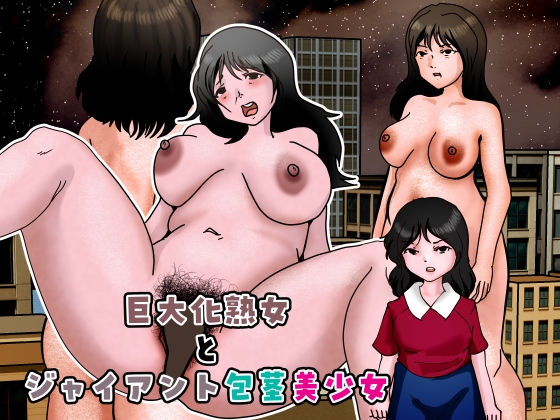
“Kyodaika (Giantess)” works on DLsite
Gulliver in Brobdingnag, his head no bigger than the queen’s hand. The image is from Swift’s 1726 Gulliver’s Travels, but the underlying interest — in how scale itself organises a relationship — is older than the novel and continues to organise a corner of contemporary fictional adult media. Kyodaika names the Japanese-subculture version of that interest.
Overview
Kyodaika (Japanese: 巨大化, “becoming enormous”; in Japanese subculture also written as kyodai-ka or kyodai-musume) is the Japanese genre name for fiction that depicts characters at dramatically larger-than-human scale, with the resulting scale-relationship as the work’s organising premise. In international adult-content vocabulary, the corresponding genres are Giantess (often abbreviated GTS) and macrophilia, and the three terms are largely interchangeable in fan usage even where their academic and origin contexts differ.
It is essential to read the entire category as fictional. Kyodaika is centred on the depicted fictional enlargement of fictional characters in fiction, and the genre’s working vocabulary is built around fictional bodies in fictional settings — fantasy worlds, science-fiction settings, fantasy mythological frames, transformations triggered by fictional radiation, alien biology, magical contracts, and so on. The fictional frame is part of how the genre operates, and the contemporary ethical perimeter follows the standard one for fictional adult media (see the wider eroge and doujinshi traditions).
The genre’s centre of gravity is in two-dimensional drawn media: manga, illustration, eroge, eromanga, doujinshi, CG sets, and 3DCG. Live-action production with VFX and CG compositing exists but is limited; the imaginative flexibility of drawn media matches the genre’s structural demands much better than live-action production typically can. In this respect kyodaika has the same media bias as shokushu.
Etymology
The Japanese 巨大化 (kyodaika) is a three-character compound: 巨 (kyo, “enormous”) + 大 (dai, “great”) + 化 (ka, “transformation, becoming”). In its general use, the word means “becoming enormous” and is applied to physical objects, social organisations, and abstract phenomena alike (e.g. “the giantification of cities”, “the giantification of corporations”). The adult-content sub-cultural usage is a derived application of the same general noun, narrowed to the depicted bodily enlargement.
In English, giantess derives from Old French geant with the female-marking suffix -ess, and the word originally meant a female giant in mythology and folklore. Macrophilia combines Greek makros (great, large) with philia (love, fondness) and was coined in twentieth-century clinical sexology before becoming a community self-description. The two English terms are now broadly interchangeable in online community usage.
Pre-modern lineage
Giant-and-tiny relationships have a long iconographic and narrative history. The Greek Titans and Giants, the Norse jötnar, the biblical Nephilim, the Indic Asuras — every major mythology of the ancient world has a class of beings positioned between gods and humans, frequently depicted at dramatically larger scale and often appearing in narrative-significant relationships with smaller beings.
In Japan the Kojiki and Nihon Shoki preserve the Daidarabotchi (大太法師) figure — the legendary giant whose footprints are said to have shaped the country’s geography — and the Konjaku Monogatarishū and Uji Shūi Monogatari tell tales of monstrous giants in encounters with ordinary humans. These pre-modern sources are not the genre’s direct origin but supply part of the cultural soil on which the contemporary genre grew.
In early-modern Western literature, François Rabelais’s Gargantua and Pantagruel (1532–1564) and Jonathan Swift’s Gulliver’s Travels (1726) established giants as literary protagonists with a worked-out interior. Swift’s Brobdingnag passage (Book II) is the most often cited reference point for the genre’s contemporary scale-vocabulary: Gulliver’s experience of being a small human among ordinary-bodied giants is the structural template that contemporary kyodaika fiction reuses repeatedly.
In twentieth-century Western popular fiction, H. G. Wells’s The Food of the Gods (1904), the 1958 film The Attack of the 50 Foot Woman, Richard Matheson’s The Shrinking Man (1956), and the wider 1950s SF tradition of size-transformation stories provided the contemporary genre’s cinematic and literary warm-up.
Twentieth-century consolidation
The genre as a contemporary sub-cultural category consolidated through the 1980s and 1990s in Japanese eromanga, doujinshi, and adult games. Contemporary critical writing (Nagayama Kaoru’s Eromanga Studies, 2006) places the formative period in the 1980s, with the tokusatsu (special-effects monster films and television) tradition’s giant-female heroines feeding into the doujinshi-and-eromanga sub-genre as a cultural source.
Through the 1990s, Comic Market and the wider doujinshi event network treated kyodaika as a stable independent category, and a recurring set of artists and circles supplied the genre’s working corpus. By the 2000s, commercial eromanga magazines were running occasional kyodaika-themed special issues, and by the 2010s DLsite and similar download platforms were treating kyodaika, giantess, and macrophilia as recognised independent tags.
The international macrophilia community
A distinct and substantial English-language macrophilia community formed in parallel from the late 1990s onward. Online communities including Giantess World, Giantess City, and the wider Western fan-fiction and CG-art ecosystem have produced a large independent body of work in the same general genre. The Western community has traded with the Japanese subculture across the language boundary throughout, with translation, mutual reference, and cross-influence operating in both directions.
The Western community has tended to develop a slightly different aesthetic centre of gravity. SF-setting transformation premises (radiation, experimental drugs, cosmic events), disaster-scale imagery (the giantess-as-city-destroyer), and the vore sub-genre (consumption-themed work, see below) have all developed more substantial Western lineages than they have in the Japanese subculture, where fantasy-setting and personal-encounter framings tend to predominate.
Sub-genres
The genre catalogue divides into recognisable sub-categories.
Giantess (female-enlarged): enlarged female figures encountering smaller male partners. The dominant mode of the genre and the source of the Giantess (GTS) label.
Giant male: enlarged male figures, less common in the dominant mode but well-represented in BL and women-oriented sub-currents.
Microphilia / shrunken protagonist: the inverse premise, where the protagonist is shrunken and the partner is at ordinary scale, producing the same scale-asymmetry from the opposite direction. The community vocabulary varies, with minigirl and microphilia both in use.
Local enlargement: enlargement of specific body parts rather than the whole figure. Bakunyu (extremely large breasts) and kyokon (extremely large penis) sit on this sub-category. The local-enlargement variant is internally complex; some artists treat it as part of kyodaika and some treat it as a distinct genre.
Vore: a category in which scale-asymmetry is combined with a consumption premise. Vore has its own substantial dedicated community, particularly in the English-speaking world, and the relationship between vore and kyodaika is a matter of community-level cataloguing rather than formal definition.
Foot-fetish kyodaika: the combination of giant-scale work with foot-fetish work, in which the giant figure’s foot is the focal element. A clearly recognised sub-current with its own dedicated artists.
Reception logic
The psychological readings of kyodaika are recurrent. Three are most often invoked. Maternal-figure regression — the giant figure as a maternal-coded enveloping presence, with the smaller protagonist’s experience reading as a regressive return to a pre-individual state. Power asymmetry — the dramatic scale difference as the simplest possible visualisation of an absolute power asymmetry, with the genre’s narrative apparatus supplying the moral framing under which that asymmetry can be read in any number of ways. Sensory novelty — the genre’s interest in the body experience that an extreme scale change would produce, with the fictional setting allowing exploration of sensory configurations real bodies cannot reach.
In the contemporary clinical literature macrophilia appears as one of the recognised paraphilic interests; the DSM-5 (2013) framework distinguishes paraphilic interest (a non-typical pattern of arousal, not pathological in itself) from paraphilic disorder (the same pattern when it produces distress or harm), and macrophilic interest in fiction belongs to the first category. The genre’s contemporary critical literature, both in Japanese-language eromanga studies and in Anglophone media studies, has approached it on similar terms.
A note on ethics in fiction
Kyodaika depicts power asymmetries that, at the scales involved, are absolute. The genre’s working ethical convention — well-established within the Japanese-subculture tradition — is the use of the fictional setting to handle the consent-and-relationship questions that would not be tractable at human scale. Different works handle the ethical perimeter in different ways; the genre as a whole carries an active critical conversation about how the fictional scale-asymmetry should be related to ordinary moral readings of relationships. The Western vore sub-current has produced the most directly violence-positive sub-tradition, and the corresponding internal critical writing is correspondingly active. The conversation is unresolved in the productive sense — the genre is one in which the reading and the depicting are continuously in dialogue with one another.
Related Terms
Updated
References
- 『Eromanga Studies』 East Press (2006) — Includes treatment of giantess and size-fetish sub-genres.
- 『Macrophilia: A Brief Introduction』 Journal of Fantasy and Fetish Studies (2014)
- 『DSM-5 — Paraphilic Disorders』 American Psychiatric Association (2013) — Modern clinical position on non-pathologising paraphilic interests.
- 『Erotic Comics in Japan: An Introduction to Eromanga』 Fakku Books (2021)
Also known as
- giantess
- GTS
- macrophilia
- size kink (giantess)
- ja: 巨大化
- ja: 巨大娘
- ja: サイズフェチ