Denim fetish
✎ 本文編集 (admin) 🖼 画像編集 (admin)“Denim fetish” works on DLsite
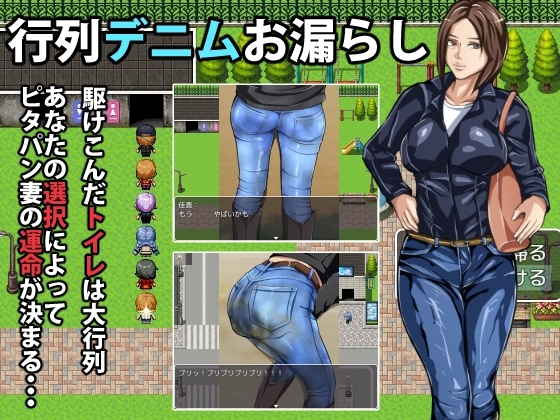
Denim fetish (Japanese: デニムフェチ, denimu-fechi; English: denim fetish / jeans fetish) is the category of sustained sexual-and-romantic attraction to women wearing denim fabric, particularly jeans. The category sits in the broader pants-fetish category, adjacent to yoga pants fetish, shorts fetish, and leather-pants fetish.
Distinction in vocabulary
The English-language vocabulary uses denim fetish, jeans fetish, and jean fetishism as essentially-equivalent terms, with denim fetish emphasising the fabric-material aspect and jeans fetish emphasising the garment-form aspect. Both terms operate in roughly the same fetish-vocabulary register.
The Japanese-language vocabulary loans the English fetish as fechi, with denimu-fechi, jīnzu-fechi, and jīpan-fechi (the last using the Japanese-coined contracted form jīpan = “jeans-pants”) parallel-circulating. The Japanese vocabulary tends to emphasise the fabric-texture and aging-aesthetic dimensions more strongly than the English-language vocabulary, with the denimu compound covering a broader range of attention to the material’s textile-and-craftsmanship properties.
Etymology and definition
Denim originates as French serge de Nîmes (Nîmes-origin cotton-twill cloth), with the abbreviated form denim circulating in 19th-century American Western-frontier work-clothing context. Tailors Jacob Davis and Levi Strauss & Co. jointly secured the US Patent No. 139,121 in 1873 for rivet-reinforced work trousers, establishing the prototype for the modern jeans form. Jeans derives from Italian Genoa (Italian: Genova) where a denim-substitute work-fabric originated, with the term initially encompassing the broader category of work trousers regardless of fabric.
Denim attraction as a clothing-fetish category branches by jeans form (straight, skinny, flare, shorts), processing (stonewash, distressed, bleached), fading degree, and body-fit closeness. Adjacent fetish-aesthetic categories include yoga-pants fetish (operating on the soft-fabric / form-conforming axis), shorts fetish (operating on the leg-exposure axis), and leather-pants fetish (operating on the hard-material axis).
History
Denim entered Japan as post-war American import culture. The 1960s Ginza Miyuki-zoku, the 1970s VAN-and-JUN fashion movement, the 1980s Levi’s 501 boom, and from the 1990s the convergence of domestic premium-denim (Evisu, Momotaro Jeans) production with the vintage-clothing boom together produced a distinctively-Japanese depth in denim culture. The Okayama-prefecture Kojima, Hiroshima-prefecture Fukuyama, and Osaka-prefecture Sakai production regions are recognised globally as quality-reference origin points.
Adult-content production’s systematisation of denim-related preferences advanced from the 1990s onward in photography, gravure, and AV genres. “Pichi-pichi denimu” (tight denim), “taito jīnzu” (tight jeans), “shōto denimu” (short denim), and “denimu sukāto” (denim skirt) operate as independent tag categories. Skinny jeans, in particular, function continuously as a body-line-emphasising device.
Structure of attraction
Denim-fetish attraction can be analysed into four layers:
The first layer is the hard-fabric texture. The thick twill weave fabric’s resistance against the body, the seam-ridge prominence, and the metallic elements (zipper, button fly) contrast sharply with soft-fabric garments (knit, cotton, chiffon), producing a distinctive hard-form profile.
The second layer is the inseam-and-yoke seam. The characteristic jeans front-and-back yoke-seam tightens the fabric at the crotch position, framing the visual gaze toward that area. The seam-pattern is a recognised aesthetic-element in jeans-design discourse.
The third layer is the waist-and-buttocks volumetric framing. The back-pocket position, size, and arrangement function as visual frames emphasising buttocks shape. Denim-fashion-industry “pocket placement” expertise treats this framing as a foundational design element.
The fourth layer is the aging patina. The accumulating wash-and-wear pattern produces individualised “body-conformed fabric” texture, with the worn-jeans aesthetic functioning as a body-record preserved in the fabric.
In sexual scene contexts, jeans operate as a representative “hard-to-remove garment”. Button-fly unbuttoning sequence, zipper-descending, and the body-fit-fabric removal motion each occupy a discrete period of time, contributing to clothed-play-type aesthetic of “half-removed garment” scene-construction.
Variants
- Skinny denim: slim-fit body-line-emphasising form
- Straight / regular: orthodox straight-silhouette form
- Low-rise denim: hip-bone-exposing lower-waist form
- High-rise denim: abdomen-covering higher-waist form
- Short denim: leg-exposing cut form
- Denim mini-skirt: overlapping with panchira context
- Denim one-piece, overall, salopette
- Raw denim: unwashed pre-aged form
- Distressed denim: torn-and-frayed decorative form
- Faded jeans: body-shape-recorded aged form
Reception and culture
Denim is a rare garment crossing work, casual, and fashion contexts, with high everyday-visibility in life. Convenience-store-return scenes, university-classroom scenes, café scenes, and post-return-home scenes all conventionally feature denim attire, making the fabric a frequent prop for “everyday-life-continuous sexual scene” framing in adult production.
Denim enthusiasts include a sub-population with substantial interest in fading process, stitching detail, and material-origin specifics. Okayama-Kojima manufacturing, vintage XX wartime-model, and red-line selvedge specialist knowledge places the category at the intersection of clothing-fetish and textile-collection hobby. Distinguishing the wearer’s motion-and-posture from the fabric-aging-record as separate objects of attention is one of the more distinctive depth-properties of denim-fetish within the broader clothing-fetish space.
The camel toe phenomenon — fabric pulled into the labial recess producing visible outline — is recognised as a distinctive denim-fetish visual element in English-language slang vocabulary, with the term operating across casual and fetish-aesthetic contexts. The Japanese vocabulary lacks a direct equivalent term, though the visual element is identically incorporated into adult-production depiction.
Related Terms
- Yoga pants
- Shorts fetish
- Panchira
- Clothed play (chakui)
- Married woman (hitozuma)
- Mons pubis (chikyu)
Updated
References
- 『Jeans: A Cultural History of an American Icon』 Gotham Books (2006)
- 『Selvedge and Heavyweight Denim: A Visual History』 World Photo Press (2011)
- 『Fashion Studies: Research Methods, Sites, and Practices』 Bloomsbury Academic (2016)
- 『The Denim Bible』 te Neues (2009)
Also known as
- denim fetish
- jeans fetish
- jean fetishism
- ja: デニムフェチ
- ja: ジーンズフェチ
- ja: ジーパンフェチ
Related
- Bloomers (Japanese school PE shorts)
- Boots fetish
- Nobura (braless)
- One-Piece Swimsuit
- Corset
- Jawline Fetish
- Blazer School Uniform
- Bodikon (Body-Conscious Fashion)
- Sexual Dimorphism Fetish (Dansa Fechi)
- Reading Fetish (Dokusho Fechi)
- Gangimari (Drugged-Face Expression)
- Hard Pounding (Gan-tsuki / Geki-pisu)