“Praise-Kink Moe (Home-Jozu)” works on DLsite




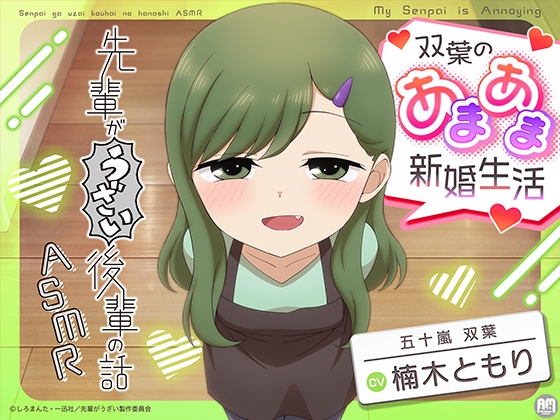
“You worked hard today.” “You’re doing it right; well done.” The compliments come out at a calm, even temperature, but they have the precision of someone who has been watching. The listener does not feel them at the temperature of social politeness; they have the weight of observed remarks. Across a single day the listener can absorb a great many of them and not get tired of any of them. The everyday procedure of having to achieve something in order to be acknowledged is, in front of this particular partner, often skipped. Existing is enough. The listener gradually realises that they had needed a stretch of time inside which they could be unconditionally affirmed.
Overview
Home-jōzu moe (褒め上手萌え, “praise-skilled moe”) names the Japanese fan-culture preference for fictional characters who are unusually skilled at giving compliments and affirmation. It overlaps the English-language praise kink category — the sexual register of being affirmed verbally — and is the Japanese form of the same broad phenomenon. The structural centre of the kink is the relationship of one-way verbal affirmation between the praise-giver and the listener.
The structural core is unconditional affirmation. The acknowledgements that an adult receives in everyday life are, with rare exception, contingent on some condition: a result delivered at work, a score on a test, an act performed for someone. Acknowledgement is paid against achievement. The praise-skilled character relaxes that conditional, or removes it entirely. The character offers the verbal return for existing, for trying, for being present.
In moe-database terms, the slot sits opposite kotobazeme (verbal taunting), the line in which the central element is also speech but in the form of attack rather than affirmation. Both lines treat language itself as the object of the kink, and the two are often layered in the same work; the difference between them is the temperature of the speech.
Lineage
The desire to be praised surfaces as an independent theme in Japanese subcultural discourse in the late 2000s. A wave of memetic confessions on the Japanese internet — “I want her to be my mother”, “I want an older sister to spoil me”, “I want to be looked after” — accumulated through the early 2010s. In parallel, the ASMR, situation-voice, and adult-audio sectors began producing large numbers of works whose central conceit is the one-way pouring of affirmative speech onto the listener.
In English-language fandom the praise kink term circulated through 2010s social media and fan-fiction criticism, and a sexual register grounded in verbal affirmation became broadly visible there too. In Japanese the corresponding cluster of desires had been carried for a long time under multiple labels — home-rare-tai (“I want to be praised”), amayakasare-tai (“I want to be coddled”), kōtei shite-hoshii (“I want to be affirmed”) — and crystallised as the independent tag home-jōzu in step with the maturation of the doujin-audio market.
Reception
The reception centre is the release of conditionality. The listener carries a steady weight of evaluative conditions in ordinary life (achievement, performance, appearance, social standing). The praise-skilled character provides a relationship inside which those conditions are lifted, at least temporarily.
The compliments also carry the requirement of accuracy. I’ve been watching properly, I’m the only one who’s noticed — those implicit premises give weight to the affirmation. Compliments that read as accurate, observed, and individuated work; empty compliments do not. The mark of attentive observation is one of the standard components of the home-jōzu character design.
In broader social terms, the current Japanese discourse around lowered self-esteem makes the demand for relationships of unconditional affirmation a steady one. The stable supply of “praise-system” and “spoil-system” situation-voice productions in the doujin-audio sector reflects that demand quantitatively.
In adult work
In adult content the standard arrangement is a stream of affirmative speech delivered during, before, and after physical contact. I can see you’re trying, you’re doing it right, you’re so good: lines of this kind, run continuously and at the right cadence, place the listener inside a structure where bodily sensation and verbal affirmation are simultaneous.
The doujin-audio, ASMR, and situation-voice categories carry stable independent markets for praise-system, spoil-system, and affirmation-specialist sub-genres. The recurring pairing is with older-sister, older-woman, and female-teacher roles, where the maternal-affirmation register adds an additional temperature. The voice actor’s tone, pacing, and line endings — the audio specifics — are the principal quality determinants.
Sub-archetypes
All-affirming girlfriend / all-affirming older sister
A character who affirms the listener no matter what. The commercial doujin-audio sector has a recognised sub-genre stream of titles that explicitly market the zen-kōtei (total affirmation) configuration.
Bedside-praise format
A pillow-talk scenario in which the partner listens to a recounting of the day’s events and affirms each item one by one. Long-form ASMR productions use this format frequently.
Senior-and-supervisor praise
The workplace variant. The mix of professional acknowledgement with a private affection toward the listener is the working centre of the moe in this configuration.
Maternal-praise
The variant that connects to older-sister and older-woman archetypes. The conditional clause is removed almost completely, and affirmation is paid for existing.
Related terms
- Verbal taunting (kotobazeme)
- Care-system moe
- Female-teacher character
- Older-sister character
- Tsundere
- Girlfriend ASMR / kanojo-roleplay audio
- Ero-ASMR
- Binaural voice
- Yandere
Updated
References
- 『Beautiful Fighting Girl』 University of Minnesota Press (2011)
- 『Otaku: Japan's Database Animals』 University of Minnesota Press (2009)
- 『The Moé Manifesto』 Tuttle Publishing (2014)
- 『More Than a Feeling: Autonomous Sensory Meridian Response (ASMR)』 PeerJ (2015) https://peerj.com/articles/851/
Also known as
- praise-kink moe
- praise-skilled character preference
- compliment-giver moe
- ja: 褒め上手萌え
- ja: 褒め上手