“Dialect Fetish (Hougen)” works on DLsite
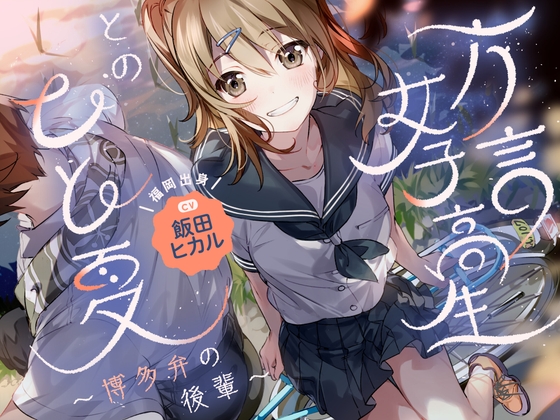

A partner who has been speaking measured standard Japanese all day will, when half-asleep, when drunk, or in the middle of being held, slip into the speech of her home region. The line endings get longer, the accents shift, and a layer of the same person becomes audible that does not normally show. Something in the listener relaxes. Dialect fetish names that response: aesthetic-and-erotic attraction to a particular regional dialect, accent, or okuni-kotoba (“home-region speech”), built around the gap between the controlled standard register and the unguarded regional register.
Which dialects
The dialects most frequently cited in the fandom literature are biased toward specific regions. The Kansai dialect, with its soft sentence-final particles (~yan, ~yade, ~nen) and brisk tempo, is read as bright and intimate and is consumed in lover-character configurations. The Hakata / Fukuoka dialect, with its ~to?, ~ken, and slightly higher overall intonation, is read as cute and used heavily in college-student and office-worker character designs.
The Tohoku dialects (especially Akita, Aomori, and Iwate variants) are read as plain and unspoiled, and are deployed in rural and pastoral settings. The Tosa and Satsuma men’s-speech variants are deployed as the marker of masculine roughness in male characters. Kyoto speech — ~dosu, ~haru — is used in the elegant-and-older-woman register and in scenes coded with sensual maturity. Okinawan speech is used in the southern-island and release register.
The same kind of preference is observable in English-language fandom: British accents, Irish lilts, Southern accents, Scottish accents are all the recurring targets of the analogous fetish discussion in English-language fetish forums.
Reception: the gap with the standard register
The structural core of the dialect fetish is the gap with the standard register. A partner who has been holding a business-distance standard Japanese all day, and who then suddenly lets a regional form slip, is registered by the listener as the underlying self showing. The mechanism is the same as the involuntary blush (akagao) — the more uncontrollable the leak, the more reliably it functions as a sign of intimacy.
A character who uses the regional dialect from start to finish, by contrast, has the regional identity treated as the spine of the character. The fixed pairings — bright Kansai-dialect heroine, introverted Tohoku-dialect heroine — are recurring stable symbols in the design grammar.
In sexual contexts the dialect operates as the intimate register of the voice. Standard Japanese is associated with the public sphere, the workplace, and the tatemae register. Dialect is associated with the private sphere, the family, and the honne register. The switch from standard to dialect in a bed-scene is therefore a strong sign of intimacy in the genre’s symbol grammar, and is deployed as such.
In fiction and audio
The doujin-audio market has a settled sub-line of works built around dialect. The DLsite audio catalogue carries dedicated search tags for Kansai-dialect, Hakata-dialect, and Tohoku-dialect productions; both unaltered native dialect from a voice actor of that region and acted dialect rendered by a non-native voice actor with coaching are common configurations.
In light novels and visual novels the dialect-speaking heroine is a stock figure — the Kansai-dialect childhood friend, the Tohoku-dialect country girl, the Kyoto-dialect classic beauty — and the configurations are part of the standard character-design grammar. Manga and anime productions in recent years more often run dialect-supervision passes for accuracy, and there has been a steady rise in works that take the trouble to render regional speech well rather than as broad caricature.
Adjacent kinks
The fetish has obvious neighbours. Distinctive sentence-final particles in fictional speech (~daze, ~na no ja, ~nyo), the mixing of honorific Japanese with dialect, the broken Japanese of non-native speakers, and the male-coded first-person pronouns ore and boku used by female characters — none of these are dialects in the strict sense, but they belong to the same family: attraction to differences in language use as such.
Recent streaming culture has made it commonplace for VTubers and live-streamers to lean into their home dialect, and chat conversation around dialect-spotting has become a routine part of stream culture. The preference is no longer confined to sexual contexts; it has become a generally circulating fandom register.
Related terms
- Voice fetish
- Speech-style fetish
- Ero-ASMR
- Binaural voice
- Situation-voice
- Akagao (involuntary blushing)
Updated
References
- 『日本語方言大辞典』 Shogakukan (1989) — Major encyclopedic reference on the regional dialects of Japan.
- 『Otaku: Japan's Database Animals』 University of Minnesota Press (2009)
- 『The Moé Manifesto』 Tuttle Publishing (2014)
- 『More Than a Feeling: Autonomous Sensory Meridian Response (ASMR)』 PeerJ (2015) https://peerj.com/articles/851/
Also known as
- dialect fetish
- regional accent attraction
- okuni-kotoba attraction
- ja: 方言フェチ
- ja: 訛りフェチ
Related
- Voice fetish (koe)
- Ero ASMR
- Binaural audio (recording technique)
- Jawline Fetish
- Gangimari (Drugged-Face Expression)
- Hikikomori Character Moe
- Princess Character (Hime-Kyara)
- Praise-Kink Moe (Home-Jozu)
- Ikemen Worship
- Inkya-kei (Introverted-Character Type)
- Blushing kink (akagao)
- Bloomers (Japanese school PE shorts)