“Water play (mizu-zeme, BDSM context)” works on DLsite
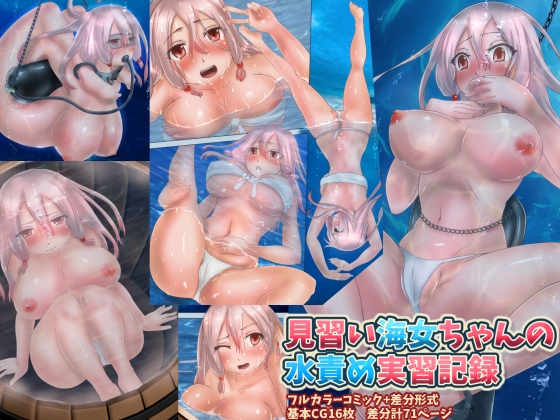
The framing first, and the framing matters. Water play names a sensory-play category within consensual-adult BDSM practice, with water-based stimuli (water droplets, ice, shower-flow, temperature contrast) deployed as scene-elements between informed-and-willing adult participants. The category is strictly distinct from any practice that risks restriction of breathing (waterboarding-style activity is not in scope of this article and should not be conflated with consensual sensory water play), from omorashi (incontinence play) which involves urinary processes rather than externally-applied water, and from any non-consensual real-world practice in the historical-or-legal record of coercive water-torture techniques. The article describes the consensual-adult BDSM sensory-play category specifically; it does not, and should not be read to, address any other use of the term.
Overview
Water play (Japanese: 水責め, mizu-zeme; alternative vocabulary: ウォータープレイ wōtā-purei; 水プレイ mizu-purei; ウェットプレイ wetto-purei; English equivalents: water play, wet play, sensory water play) is the BDSM sensory-play category in which water, ice, or temperature-contrasting water-based stimuli are deployed as the medium of sensory engagement between consensual-adult partners. The category operates within the broader BDSM-community sensory-play category alongside wax play (heat-based) and other sensory-modality categories.
The category’s structural feature is its operation on the skin-sensation register: water-based stimuli engage the skin’s sensory-receptor system directly, with temperature-and-pressure-and-flow as the engaging dimensions. The category is sensory-focused rather than impact-focused, and operates in the gentler-end of the BDSM-practice spectrum (compared with impact-play, edge-play categories), with the corresponding emphasis on sustained-sensation rather than discrete-intense moments.
Within the category, multiple distinct sub-modes operate. The dripping-water sub-mode emphasises the slow-accumulation-of-small-stimuli register; the ice sub-mode emphasises the cold-temperature register; the shower-and-flow sub-mode emphasises the pressure-and-temperature register; and the temperature-contrast sub-mode (alternating warm and cold) emphasises the contrast register. The sub-modes operate with substantially different practical-requirements and substantially different psychological registers.
Sub-modes
Dripping water (water-drop play)
A container with a small hole, or a tap-fixture, allows water to drip slowly onto a fixed point on the receiving partner’s body. The receiving partner is typically in a bondage configuration that prevents the body from moving away from the drip-point. The drip-point on the body can be specific (forehead, sensitive skin-areas) or distributed (multiple drip-points, areas of skin).
The configuration’s psychological register operates through the anticipation-and-uncertainty dimension. Each drop arrives at a slightly-unpredictable interval, with the receiving partner aware that the next drop is coming but unable to predict exactly when. The sustained attention required to anticipate the unpredictable arrival operates as a form of mental conditioning, with the small-stimulus repeated-over-time becoming an experiential dimension that the receiving partner registers as substantial despite each individual stimulus being objectively small. The configuration is sometimes called “Chinese water torture” in popular reference (which is a real historical practice in coercive contexts, and the consensual-BDSM application is not the same thing — the consensual application uses the same sensory-mechanism in a consent-framed sensory-play context).
Temperature-control of the dripping water adds an additional dimension. Cold water amplifies the sensation; warm water provides a more gentle stimulus; alternating temperatures introduce variation across the duration. The configuration’s slow-time-scale (typically extending over many minutes) gives the configuration a distinctive protracted character.
Ice play
Ice cubes or ice blocks are deployed against the receiving partner’s skin, with the cold-temperature sensation as the primary stimulus. The ice can be held against specific points (sensitive skin-areas, nipples, neck), traced across the body’s surface, or slid along the skin in continuous motion. The intense temperature-contrast against normal body-temperature produces a sharp sensation that the skin’s cold-receptors register strongly.
The combination of ice-play with wax-play produces hot-cold contrast effects, with the dramatic temperature-contrast operating as a recognised sensory-effect configuration within the BDSM-community vocabulary. The hot-cold contrast configuration works on the skin’s temperature-receptor system in ways that single-temperature-modality stimuli do not, with the resulting sensation register distinctive from either component alone.
Practical-safety considerations for ice play include: avoiding extended contact at any single skin-point (frostbite risk from extended cold-contact); avoiding application to highly-sensitive or compromised skin-areas; monitoring the receiving partner’s overall body-temperature (extended cold-exposure produces hypothermia risk); and avoiding ice-application to areas where the receiver has cardiovascular vulnerabilities.
Shower-and-flow
Shower-water or controlled water-flow is directed onto specific areas of the receiving partner’s body. The variables include flow-rate (gentle stream to high-pressure), temperature (cold, warm, hot, contrasting), and target-area (specific body-zones, sustained or moving). The bath-tub variant works similar configurations in an immersive context.
The configuration’s psychological register includes the forced-attention dimension (the receiving partner cannot escape the flow without moving away from the bondage-or-positioning configuration), the temperature-shock dimension (sudden temperature-changes produce strong reactions), and the intimate-coverage dimension (water in flow covers skin-areas in ways that punctual-stimuli do not).
Immersion configurations
Bath-tub or vessel-immersion configurations have the receiving partner’s body or face partially-immersed in water, with the configuration’s sensory dimension working on the immersive-contact register. Important safety distinction: configurations involving face-or-head immersion in water engage breath-restriction-and-drowning risk territory and require substantially different safety practices than the dripping/ice/shower configurations described above. Face-immersion configurations should not be undertaken without dedicated training in breath-restriction-play safety frameworks, and even with such training carry substantially elevated risk compared to surface-water sensory play. This article describes the configuration as part of its coverage of the category but does not endorse face-immersion practice for any reader who is not already specifically-trained in the relevant safety framework.
Sensory-effect mechanism
The category’s effectiveness as a BDSM sensory-play category rests on several intersecting sensory-mechanism features.
Uniform skin-contact. Water contacts the skin uniformly, covering surface-area in a way that punctual-stimuli do not. The skin’s distributed sensory-receptor system registers the contact across a substantial area simultaneously, producing a whole-body-aware sensation that punctual stimuli cannot replicate.
Cavity-and-crevice penetration. Water-as-liquid enters body-contours and skin-folds that solid-stimuli cannot reach. The “no-place-to-hide” register of the sensation extends the sense of being-engaged-by-the-stimulus beyond what surface-only contact would achieve.
Temperature-receptor engagement. Cold-water and warm-water stimuli engage the skin’s temperature-receptor system directly, producing strong sensory responses on a different neural-pathway than mechanical-pressure receptors engage. Sensitive areas of the body have correspondingly-stronger temperature-receptor density, producing differentially-strong responses at those areas.
Anticipation-and-unpredictability. The dripping-water configuration in particular operates on the anticipation register, with the unpredictable arrival-time of the next stimulus producing sustained mental-engagement that the small-individual-stimulus would not produce in isolation.
Combination effects. The category’s combination with bondage configurations, with wax-play, or with other sensory-play modalities produces composite-sensation registers that engage multiple receptor-systems simultaneously.
Safety
The category sits in the moderate-risk zone of BDSM sensory-play, with practical safety-requirements that apply across most configurations:
Face-and-head-exposure caution. The most important safety dimension concerns face-and-head exposure. Configurations that risk water entering the airway (face-immersion, intense flow over the face, restraint configurations that prevent the receiving partner from moving the face away from water) engage breath-restriction risk that is substantially more dangerous than surface-skin water-contact. The general rule for the category: water on skin is comparatively low-risk; water on face is comparatively high-risk and requires substantially different safety practice.
Temperature-extreme caution. Extended exposure to cold (extended ice-application, cold-water immersion) carries hypothermia risk; extended exposure to hot (very-warm-water configurations) carries burn-and-scald risk. Both extremes require monitoring of the receiving partner’s overall thermal status, with caution about extended single-modality exposure.
Frostbite-and-tissue-injury caution. Ice held against any single skin-point for extended duration produces frostbite. Standard practice keeps ice in motion or alternates application-points.
Cardiovascular caution. Receivers with cardiovascular vulnerabilities (heart conditions, blood-pressure issues) face elevated risk from sudden-temperature-shock configurations. Pre-scene negotiation should establish the participants’ cardiovascular history and adjust the practice accordingly.
Communication-maintenance. The receiving partner’s capacity to communicate (verbally or with safeword-equivalent signals) needs to be maintained throughout the practice, with attention to configurations (gags, immersion) that might compromise communication-capacity.
Hygiene. Water used in the practice should be clean; equipment used should be clean; post-practice attention to drying and skin-care prevents secondary issues (skin-maceration from extended-water-exposure, etc.).
Position in adult-content production
Adult-content production deploys water-play configurations in several distinct registers.
Bondage-and-SM productions deploy ice-play and dripping-water configurations as recognised sensory-play scene-elements. The configurations operate within the broader specialist-SM production-grammar, with the practical-safety material handled within the production-context’s frame.
Shower-and-bath-themed productions deploy water-flow configurations in less-explicit sensory-play contexts, with the water-flow as a scene-element rather than as a centred sensory-play modality. Mainstream Japanese adult-video production includes substantial shower-and-bath-scene material that operates in this register.
Specialised water-play-focused productions exist as a niche, with dedicated production-labels and series. The niche is smaller than for other sensory-play categories (wax-play is the next-larger neighbouring sensory-play category in Japanese production-distribution) but operates as a recognised independent category.
Distinctions
The category is distinct from several adjacent categories that share some features:
Omorashi (urinary-incontinence play): a separate category involving urinary processes rather than externally-applied water. The two are sometimes grouped under “water-related” headings but operate on fundamentally different mechanisms.
Waterboarding and water-torture (coercive contexts): an entirely separate phenomenon — a coercive interrogation-and-torture technique in historical-and-real-world contexts. Not in scope of this article and not equivalent to the consensual-adult sensory-play category. The shared vocabulary-word water and the shared sensory-mechanism creates a surface-similarity that should not be allowed to obscure the fundamental difference: consensual-adult sensory-play and coercive-real-world-torture are different categories with different ethical-and-legal status.
Breath-restriction play (consensual): an adjacent BDSM category with its own practice-and-safety framework, distinct from water-play. Some water-play configurations (especially face-immersion variants) engage breath-restriction-territory and consequently require breath-restriction-play safety-frameworks rather than water-play frameworks alone.
Related Terms
- SM culture — the parent practice-context
- Wax play (rousoku-zeme) — the adjacent heat-based sensory-play category
- Omorashi (incontinence play) — adjacent water-related category, distinct content
- Bondage (kousoku) — typical companion practice-configuration
Updated
References
- 『Different Loving: The World of Sexual Dominance and Submission』 Villard Books (1993)
- 『Jay Wiseman's Erotic Bondage Handbook』 Greenery Press (2000)
- 『The Ethical Slut』 Greenery Press (2009)
- 『Two Knotty Boys Showing You the Ropes』 Green Candy Press (2006)
Also known as
- water play
- mizu-zeme
- water play (SM context)
- wet play
- ja: 水責め
- ja: ウォータープレイ
Related
- SM (Japanese SM Culture)
- Omorashi (incontinence kink in fictional context)
- Hana to Hebi (Flower and Snake)
- Nyoudou-zeme (Urethral Play / Sounding)
- Fisting
- Jirashi (teasing / sexual denial)
- Shallow teasing bounce (jirashi-jouge)
- Kanchou (enema, in adult-fiction context)
- Face-burying position (kao-nose)
- Kotoba-zeme (verbal teasing)
- Erotic asphyxiation (kubishime play)
- Nipple-clamp (kink and device)