Android / Gynoid Erotica
✎ 本文編集 (admin) 🖼 画像編集 (admin)“Android / Gynoid Erotica” works on DLsite



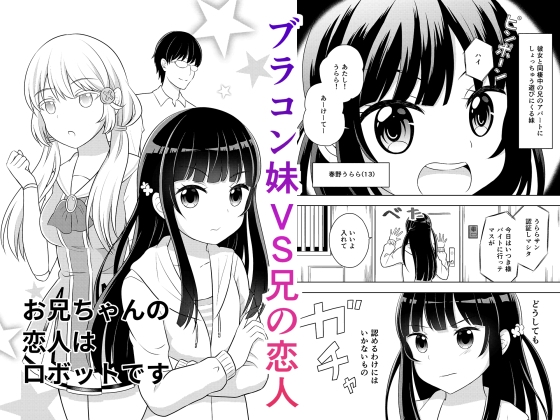



When you open the box that arrives in the room, a maid of a form indistinguishable from a human rises to her feet. A faint point of light blinks deep in her eyes, and the first voice she utters is that of a perfect human woman. To this being announcing “Master, I will begin the initial setup”, the viewer finds a wholly obedient and wholly made partner. Android / gynoid erotica (機械娘 / アンドロイドエロ, kikai-musume / android ero) is the collective term for adult creation taking androids, gynoids, cyborgs, and artificial humans as its subject, a sub-genre at the crossroads of SF literature and love-doll culture.
Overview
This genre depicts an artificial female being (rarely a male one) as a sexual partner. It includes android (male-form humanoid), gynoid (female-form humanoid), cyborg, homunculus, and maid-robot types, a setup repeatedly adopted in SF, fantasy, eroge, and eromanga. The principal bearers are eroge, eromanga, doujin audio, and adult light novels, with the construction of introducing an android heroine within an SF-setting work standardised.
The core: perfect obedience and the question of the soul
The core consists of two axes. One is perfect obedience: a being who, by programming, cannot disobey the owner’s command, voices no complaint, does not tire, does not age, and keeps an eternally young and beautiful body, functions as an ideal partner who has erased the uncertainty of human relationships. The other is the question of the soul: when a wholly obedient being shows, at some moment, a real emotion, the owner is shaken. The difference between an “I love you” issued according to the manual and one spun spontaneously is almost imperceptible in outward form, but decisively different in inner meaning, and the hesitation over that difference forms the narrative core.
Literary sources
Auguste Villiers de l’Isle-Adam’s The Future Eve (1886), in which Edison (as a character) builds the perfect artificial woman Hadaly and gives her to a young nobleman, is the earliest masterpiece of android literature. Philip K. Dick’s Do Androids Dream of Electric Sheep? (1968) posed the philosophical question of the boundary between replicants and humans, visualised in Ridley Scott’s Blade Runner (1982). Japanese manga and anime have repeatedly drawn the motif of a soul dwelling in a mechanical body: Chihiro in Osamu Tezuka’s Phoenix: Resurrection, Motoko Kusanagi in Masamune Shirow’s Ghost in the Shell, the gynoids of Production I.G’s Innocence. In eroge and eromanga, works carrying the trappings of SF and the supernatural frequently adopt the setup: maid-robot heroines, homunculus lines, cyborg work, and the like. In eromanga, creators have published work depicting maid robots and artificial-human heroines.
Variants
The maid-robot form has a maid robot, whose duties are housework and personal care, serving the protagonist; “Multi” (Leaf’s To Heart) and similar are representative, established as a popular heroine type in bishōjo games. The standard narrative develops the robot’s affection for the protagonist in a domain outside the program, between household tasks. The cyborg and modified form has a being with mechanical parts built into a human body, where the wavering of the inner life (loss of memory, discomfort at bodily modification, conflict with the original humanity) colours scenes of sexual contact, often adopted in more SF-leaning work. The love-doll and figure form is continuous with love dolls and adult figures, on the extension of the taste for an artificial object as sexual partner; where a love doll or figure is an unmoving formed object, the android is a formed object one step advanced, one that moves, responds, and may hold emotion. The AI-connection form: in recent years connection with AI erotica and dialogue AI has progressed, expanding the domain of taking as a sexual object a “conversing artificial being” with no physical body, the question of the boundary of soul and machine that the android genre has handled reactivating through contemporary AI dialogue technology.
Reception psychology: perfection and lack together
The core that draws enthusiasts is the contradiction of being both a perfect partner and a partner bearing a lack. A being who exceeds the human in looks, obedience, and durability is inferior to the human in emotion, soul, and free will. This inferiority evokes the owner’s protective, educative, and attachment impulses, driving the relationship as story. If a love doll offers “an unmoving ideal partner”, android erotica offers “a responding ideal partner”; the two are continuous in the taste for an artificial object but contrast in the depth of relationship.
Related terms
Updated
References
- 『The Future Eve (L'Ève future)』 (1886)
- 『Do Androids Dream of Electric Sheep?』 (1968)
- 『Blade Runner』 (1982)
Also known as
- android erotica
- gynoid erotica
- robot-girl theme
- ja: アンドロイドエロ
- ja: 機械娘
Related
- Ecchi (Japanese Softcore Erotic Genre)
- Hana to Hebi (Flower and Snake)
- Haramase-mono (impregnation genre)
- Idol-producer theme (J-adult media)
- Sacrificial-victim genre (J-hentai)
- Training/development eroge
- Illustration collection (doujin art book)
- Isekai genre (Japanese fantasy/adult setting)
- Live-action eroge
- Female-teacher genre (J-adult fiction)
- Women-oriented AV
- Pure-love genre (junai-kei)