Iribitari (Lodger Cuckolding)
✎ 本文編集 (admin) 🖼 画像編集 (admin)“Iribitari (Lodger Cuckolding)” works on DLsite





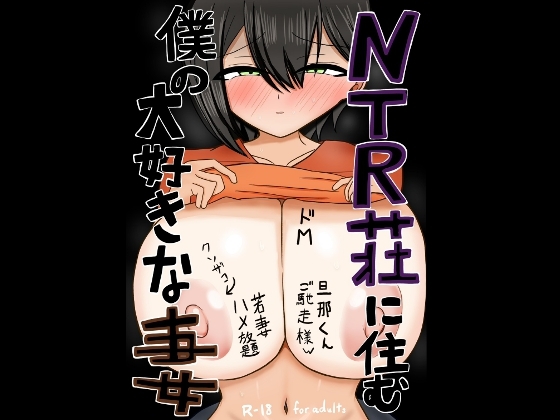


The household next door, a childhood friend’s home, a junior’s girlfriend’s room. The outsider who has slid into someone else’s living space over a long time is, one day, genuinely taking the relationship away. Iribitari is the slowest-moving narrative type within the cuckolding family.
Iribitari (入り浸り, “lingering/loitering long-term”) is the narrative type and taste in which a third party settles into a particular household, residence, or relationship over an extended period and erodes it from inside until the sexual relationship is seized. As a derivative of the netori (taking) and netorare (being cuckolded) family, it acquired the outline of an independent genre in adult manga and doujinshi from the 2010s onward.
Overview
The core structure of iribitari is erosion over time. The story begins as a third party (a neighbour, a senior or junior, a relative, a childhood friend) starts coming and going from the target household. The early relationship is ostensibly goodwill, friendship, or chance, but through accumulated visits the outsider melts deep into the household’s living space. A sexual relationship with the target is finally established, and the original partner (husband, lover) either never recognises the process to the end, or recognises it only when the relationship is already entrenched.
Within netori and netorare works, iribitari is marked by the length of its timeline. Against the standard pattern in which a relationship forms through immediate seduction or forceful intrusion, iribitari forms it across days, weeks, or months. The accumulation of unremarkable everyday scenes prepares the eventual sexual transgression: it is a narratological structure. In the adult manga and doujinshi field the genre has formed around particular authors’ bodies of work, holding consistently high rankings on FANZA Books.
Etymology
Iribitaru is standard Japanese, a verb for the state of settling into someone else’s home or place for long stretches and not leaving. The original sense carries no sexual implication; it has been used as a general term for inappropriately close proximity in domestic or social relations. In subcultural context, iribitari is a repurposing of the original sense as a sexual narrative type: not a redefinition of the word itself, but a behavioural type relocated into a sexual story. citation needed
The word’s emergence as an independent genre proceeded through the 2010s. Before that it was handled inside more inclusive terms such as netori and adultery; as a narrative type marked by length of timeline, iribitari acquired its own label. In English the analogous narrative types travel as gradual netorare or slow-burn cuckolding, with the loanword iribitari used where Japanese specificity is to be stressed.
History
The narrative type in which a third party enters a household and erodes the relationship recurs throughout world literature: the lady and the visitor in ancient Greek tragedy, the love-triangle novels of modern Japanese literature such as Sōseki’s Mon and Kokoro, and Tanizaki’s The Key, all sit as distant literary forebears of the iribitari type.
The adult netori and netorare genres formed as independent categories in adult manga and doujinshi from the late 1990s. Works of that period had relatively short erosion timelines, with immediate seduction or forceful sexual intrusion as the standard; long-timeline iribitari-like stories remained at the level of a particular author’s style. From the 2010s, works marked by length of timeline increased within the cuckolding field, and titles bearing “iribitari” or “settling in” as title or tag began to be released consistently. Genre divisions at commercial adult-manga magazines and doujinshi conventions reached the stage of operating iribitari as an independent tag. The popularity of particular authors’ series, the formula of eroding multiple heroines one after another by lingering, drove the genre’s separation. By the 2020s, works containing “iribitari” held consistently high FANZA Books rankings, and derivation and differentiation atop the established formula advanced (“reverse iribitari,” “multiple-household iribitari”).
Variant forms
In the neighbour type, a local resident (next door, the same apartment building) lingers in the target household; geographic proximity is the story’s premise, and overlapping living spaces supply continual opportunity for erosion. In the friend or junior type, a friend or senior/junior of the target’s husband or lover lingers under the guise of a relationship, the ostensible friendship masking the sexual relationship advancing beneath it. In the relative or family type, a relation of the target (brother-in-law, uncle or aunt, nephew or niece) lingers, the family tie supplying justification for the long stay. In the childhood-friend type, a third party with a long history of childhood friendship lingers, the length of the shared past supplying a situation in which the husband or lover finds it hard to feel wariness.
As an adjacent positioning: where netorare centres the one being taken from, netori the one taking, and netorase the one who voluntarily offers, iribitari places length of timeline rather than any single viewpoint at the narrative axis. The viewpoint is free per work, and both taking and taken-from perspectives hold.
Reception
The core of the iribitari taste is often discussed as the visualisation of progression. Unlike immediate sexual transgression, iribitari depicts each stage of erosion along a timeline: first contact, growing intimacy, dependence, sexual contact, reversal of the relationship. The reader is placed to observe the erosion step by step, and the process itself forms the core of the narrative pleasure. citation needed
Read from the taking viewpoint, the process of building the target’s trust over time and finally betraying it is consumed as an achievement of conquest. Read from the taken-from viewpoint, the temporal dread of a betrayal advancing inside daily life functions as the genre’s distinctive psychological structure. By using everyday human relations, family, local community, neighbourhood, as its narrative apparatus, iribitari is closely tied to the living patterns of contemporary Japanese society, with the communal structures of apartment blocks and residential districts serving continually as its setting.
See also
Updated
References
- 『Eromanga Studies』 East Press (2006)
- 『Erotic Comics in Japan: An Introduction to Eromanga』 Amsterdam University Press (2021)
- 『Otaku Yougo Jiten Dai-Genkai』 Sanseido (2023)
Also known as
- iribitari
- lodger cuckolding
- long-term infiltration theme
- slow-burn cuckolding
- ja: 入り浸り
Related
- Fantia
- Hentai Manga
- Mind Break (Hentai Tag and Narrative Type)
- Oyakodon (Mother-Daughter Threesome Trope)
- Sisters Threesome (Ane-Imouto Don)
- ASMR (Autonomous Sensory Meridian Response)
- Chijoka (Becoming a Lustful Woman)
- Gakuen-mono (School-Setting Genre)
- Ishukan
- Ahegao
- Massage Play
- Oho-goe (Oho Voice)