Sisters Threesome (Ane-Imouto Don)
✎ 本文編集 (admin) 🖼 画像編集 (admin)“Sisters Threesome (Ane-Imouto Don)” works on DLsite
This article describes a fictional Japanese adult-entertainment genre and does not endorse or normalise incestuous relationships in real life. All character ages in commercial works of this type are eighteen or older.
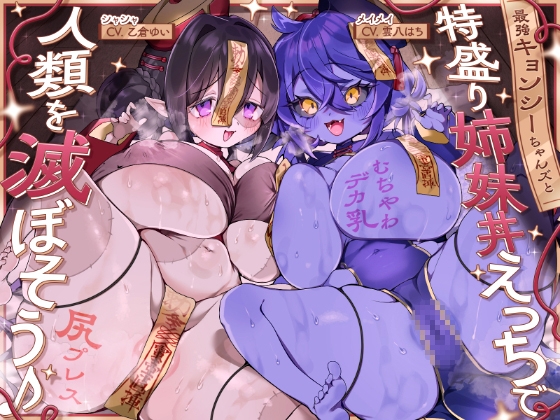
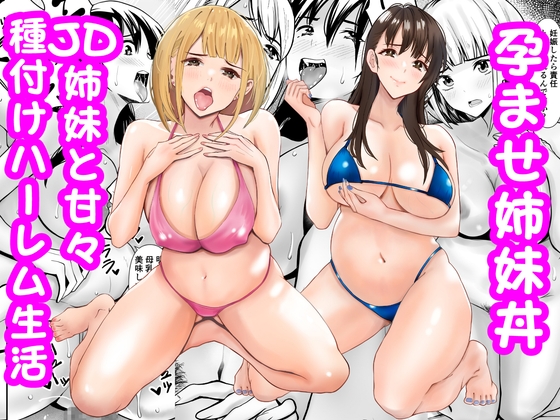
The classical staging: one shared room, two visibly related women, one man at the centre of their attention. The two sisters have the same facial structure, the same vocal range, even the same gestures from years of shared upbringing, but they react to the situation differently. The friction between what is identical and what is not is the structural point of the genre.
Overview
Ane-imouto-don (姉妹丼, “sisters bowl”) is a Japanese adult-manga, doujinshi, and eroge narrative type in which one male character enters a sexual relationship with an elder and a younger sister, either simultaneously (the three-way variant) or sequentially (the consecutive variant). The genre is one of the standard relationship-configuration tags in adult manga distribution and circulates as a recognised category in commercial and amateur publishing.
The shared structural problem of the genre, and what defines it against ordinary harem scenarios, is the contrast of similarity: two women who share a face, an upbringing, and frequently a household, who nevertheless diverge in personality, manner, and sexual response. The genre is organised around the reader’s tracking of those differences against the shared background.
Etymology
The word don (丼) is the Japanese word for a rice bowl with toppings, and is used metaphorically in adult-fandom slang to label scenarios in which multiple women share one man. The system has spawned a stable nomenclature: oyako-don (parent-and-child sisters bowl, mother-and-daughter), tanin-don (strangers bowl, unrelated women), ane-imouto-don (sisters bowl), and other compounds. The metaphor is deliberately flat; it gestures at the configuration without committing to a particular emotional register, and provides the genre with a label that is operative without being explicit.
The construction appears to have stabilised in early-2000s adult doujinshi and adult-manga distribution slang, by which point the tag had become standard on amateur-publishing search systems.
Structural variants
The genre divides into two formal sub-shapes.
The simultaneous form (“three-person” variant) places both sisters and the man in a single ongoing relationship, with all parties aware of the configuration. The shared structural problem is negotiation: how the sisters coordinate, what each is willing to do in front of the other, how they handle the asymmetries of attention. The conventional setting is one in which a shared circumstance (cohabitation, family arrangement, fantasy-setting custom) frames the simultaneous arrangement as natural rather than transgressive.
The consecutive form develops the relationship serially: the man becomes involved with one sister, and the other sister later joins, discovers, or assumes the same position. The conventional plot arc is discovery–jealousy–reconciliation–accommodation. The dramatic mass of the narrative is in the second sister’s reaction and the eventual settlement.
Both forms share a defining staging move: a scene in which the two sisters are deliberately framed together while the contrast between them is foregrounded. The hair colour, the choice of pyjamas, the speech register, the way each responds to the same question: the visual and verbal devices for making the sisters legible as similar but distinct are the genre’s most consistently maintained craft conventions.
Relation to incest framing
The genre sits adjacent to the incest-themed family of narrative types but does not necessarily belong to it. The male partner is, in mainstream commercial form, conventionally written as not blood-related to the sisters: a stepbrother, a fiancé, a tutor, a childhood-friend household member, a brother-in-law. The choice keeps the configuration outside the explicit sibling-incest taboo while preserving the family-house setting that makes the genre’s intimacy work.
A smaller stream of work pushes into explicit sibling-incest framing, in which the man is the brother of both women and the work consciously crosses Lévi-Strauss’s basic kinship taboos. This branch is more often produced in non-commercial doujinshi than in mainstream commercial publishing, where age-of-character and family-relationship policies typically constrain the framing.
Reception
The supporting psychology of the genre is most often described in three ways.
The first is contrast efficiency. Putting two similarly-faced women in one frame makes their differences instantly legible. The reader does not need to be told that one sister is the steadier one and the other is the more impulsive; the comparison reads off the page in the way the same single character cannot deliver. The genre is, in this sense, a high-information-density form of adult fiction.
The second is the sisterly side-channel. Much of the genre’s emotional texture lies not in the man-to-sister interactions but in the sister-to-sister exchanges that bracket them: a glance over the man’s shoulder, an agreement reached without speaking, a moment where one teaches the other. These side-channel moments produce a reader-position that watches both the central interactions and the parallel sisterly negotiation, and the doubled attention is a substantial part of the genre’s hold.
The third is bounded multiplicity. Where harem scenarios scatter attention across many partners, ane-imouto-don keeps the configuration at exactly two. The two women remain legible as distinct individuals throughout, and the relationship can sustain a level of psychological detail that diffuse-harem structures struggle to maintain.
See also
- Sibling incest fiction (kyoudai-soukan)
- Harem (harem mono)
- Simultaneous insertion (douji-sounyuu)
- Mother-son incest fiction (boshi-soukan)
- Stepsister (gishi)
Updated
References
- 『Erotic Comics in Japan: An Introduction to Eromanga』 Amsterdam University Press (2021)
- 『Adult Manga: Culture and Power in Contemporary Japanese Society』 Curzon Press (2000)
- 『The Elementary Structures of Kinship』 Beacon Press (1969) — Foundational anthropology on incest taboo.
Also known as
- sisters threesome
- ane imouto don
- sisters scenario
- ja: 姉妹丼
- ja: 姉妹3P
Related
- Oyakodon (Mother-Daughter Threesome Trope)
- Chijoka (Becoming a Lustful Woman)
- Mind Break (Hentai Tag and Narrative Type)
- Bakajoshi (Airhead Girl Archetype)
- Twins Moe (Futago Moe)
- Step-Parent Theme (Giri no Oya-kei)
- Ishukan
- Kyoudai Soukan (Sibling Incest Genre)
- Mesu-ochi (Falling into Female Submission)
- Gothic Lolita
- Iribitari (Lodger Cuckolding)
- Menhera (Emotionally Unstable Archetype)