Menhera (Emotionally Unstable Archetype)
✎ 本文編集 (admin) 🖼 画像編集 (admin)“Menhera (Emotionally Unstable Archetype)” works on DLsite
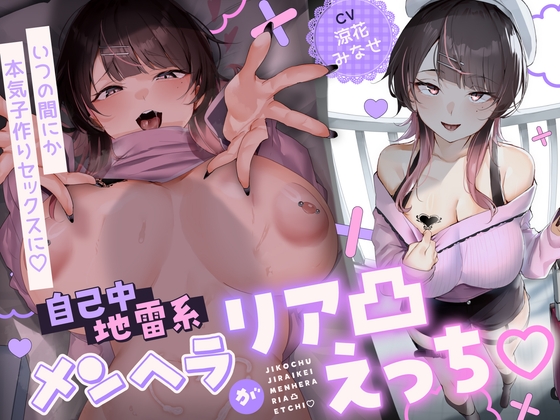


“Hey, do you like me?” arrives as a message at two in the morning. When the reply is slow, more follow: “Have you started to hate me?” “Sorry, I’m a bother, I’ll disappear.” It is neither anger nor accusation, just words to prop oneself up, fired off at another person. The aim of attack points not outward but inward, trying to confirm a relationship by injuring oneself. Menhera is consumed as subcultural slang, but it has also been discussed persistently in net culture as an emotional structure often found within the strain of contemporary Japanese personal relations.
Menhera (メンヘラ; menheru) is slang for an emotionally unstable personality with tendencies toward dependence on others, self-harm, and self-destruction, or for a character attribute thematising that nature. It derives from an abbreviation of “mental health.” Born on 2000s message boards, it now operates in both a real-world register (a term of personal appraisal) and a subcultural register (a character-attribute term). It overlaps in part with the yandere emotional structure but is distinguished structurally in that the direction of attack turns toward the self rather than outward at the object.
Overview
The core features of menhera are instability of self-evaluation, excessive dependence on personal relationships, extreme fear of losing a relationship, and a tilt toward self-harm and self-destructive behaviour. A surface relationship that is calm and intimate destabilises sharply, and attachment to another manifests as attack on the self; this is where the internal structure diverges from the yandere, which develops into external attack.
Subcultural use is varied: types that depict it as the extremisation of pure love, types that depict it as comic or parodic, types that place it as a heroine in romance-simulation stories, and types that run it as a theme of dependent relationships in adult works. Where the yandere holds the staging potential of external attack, menhera places dependence and self-harm at its core, so the two build narrative tension differently.
In the real-world register it circulates as “menhera disposition” or “menhera girlfriend” in social media, message boards, and daily conversation. The word is slang, not a psychiatric diagnostic concept, and criticism of its confusion with, and stigmatising effect on, medical concepts such as borderline personality disorder, depression, and dependent personality disorder has been raised repeatedly.
Etymology
Menhera derives from an abbreviation of “mental health.” The direct origin is the slang “menheru,” “menhera-,” and “menhera” for residents of the “Mental Health Board” (abbreviated menheru-ita) of the 2channel (now 5channel) message board. The board operated from the early 2000s as a place of exchange for users carrying mental illness, self-harm, and suicidal ideation.
“Menhera” came into general circulation in the early 2010s. With the spread of social media such as Twitter, a culture of declaring one’s own mental instability online spread, and “menhera” circulated as a slang term for that personality type. In parallel, subcultural use expanded to denote a dependent, self-harming character attribute. Derivatives such as “menhera girl,” “menhera boyfriend,” “menhera disposition,” and “tangled menhera” circulate in parallel forms by context.
History
From the late 1990s into the 2000s, interest in mental illness and psychological distress widened in Japanese society. Medical concepts such as depression, panic disorder, and eating disorders entered general vocabulary and circulated widely through television, magazines, and books. Within that social context, a basis arose for net users carrying psychological distress to form their own communities.
The 2channel Mental Health Board opened around 2000 and operated as a place of exchange for residents with psychological distress. The slang “menhera-” and “menhera” for board residents arose in the same period and was used on and off the board. Early usage carried a self-deprecating, self-mocking aspect and served as a self-identifying term.
With the spread of social media, the word circulated widely as general otaku slang. Both “self-menhera-isation” (declaring one’s own mental state on social media) and “other-menhera-isation” (the word as a tool for critiquing others) developed in parallel. The word’s position stayed unsettled, carrying both self-mocking, affectionate nuance and critical, contemptuous nuance. From the 2010s, menhera came to be positioned as a character attribute in subculture, with dependent, self-harming characters increasingly drawn as “menhera-type” in manga, anime, light novels, eroge, and doujin audio; the structural difference from the yandere attribute is debated within the field.
Structural features
The structural core of menhera expression lies in the direction the aggression takes. Anger, dissatisfaction, and anxiety turn not outward (at the object, a rival, society) but inward (self-harm, self-denial, self-destruction). Wrist-cutting, overdose, and destructive romantic behaviour are drawn as representative expressions of self-attack.
The menhera figure tends to depend excessively on the relationship with a particular object. The continuation of the relationship becomes the ground of one’s existence, and extreme anxiety and fear are shown at the possibility of its loss. This dependence structure imposes an excessive emotional burden on the object too, destabilising the relationship itself.
The repetition of confirming behaviours, “Do you like me?”, “Have you come to hate me?”, “Are you happy with me?”, is a typical staging. A positive answer from the object is needed repeatedly, and when it is not obtained, or when faced with a negative reaction, a sharp drop in self-evaluation and a tilt toward self-attack arise. The menhera figure’s self-evaluation oscillates violently between extreme self-affirmation and extreme self-denial, finding a stable middle difficult to maintain, with slight changes in relationships, events, or feelings triggering the swing.
Derivative and adjacent concepts
Menhera and the yandere can overlap in the root of the emotion (excessive dependence and love for the object) but differ fundamentally in the direction of behavioural expression. The yandere develops into external attack, reacting aggressively to a rival or the possibility of separation and seeking to achieve monopoly of the object by physical and psychological means. Menhera develops into internal attack, with instability of self foregrounded and the relationship reconfirmed through self-denial, self-harm, and self-destruction. Overlapping figures exist, but they are often classified by differences in intensity and orientation.
The tsundere and kuudere are attributes with a duality of surface and interior, structurally different from menhera: the former stage a gap between a cold surface and an interior of affection, whereas menhera is consistent in being dependent and unstable in both surface and interior. The menhera figure also overlaps in part with the psychological concept of codependency, which centres on excessive dependence on others and loss of self-boundaries and has a body of medical and psychological research. The slang and the concept do not fully coincide: the former includes transient emotional states and character staging, while the latter denotes a persistent relational pattern.
In adult works (eromanga, eroge, doujinshi, doujin audio), the menhera attribute is sometimes combined with themes of dependent relationships and training. Strong emotional binding by a character who declares “I’ll die if you leave,” fusion with yandere confinement, and scenarios thematising codependency are among the varied forms of menhera consumption in subculture.
Cultural reference and ethical handling
Menhera is slang, not a psychiatric diagnostic concept, and should be sharply distinguished from medical concepts such as borderline personality disorder, depression, dependent personality disorder, and complex PTSD. The possibility that subcultural consumption functions as a stigmatising label against people with real mental illness has been raised continually by affected communities and the medical field. citation needed
From 2015, critical discussion of the word’s use has been raised from advocacy groups and the psychiatric field, arguing that it can work to make light of the suffering of those with real mental illness, or to process relational difficulty as “an individual’s abnormality.” In parallel, a movement of self-identifying appropriation of the word by affected people themselves (self-deprecating, self-liberating use) continues. The word operates in Anglophone otaku communities too as the loanword menhera; there, however, it tends to be discussed in relation to medical and psychological concepts such as BPD and codependency, and the slang lightness of the Japanese does not fully transfer, a difference reflecting cultural attitudes toward mental illness.
See also
Updated
References
- 『Otaku Yougo no Kiso Chishiki』 Takarajimasha (2014)
- 『Cognitive-Behavioral Treatment of Borderline Personality Disorder』 Guilford Press (1993)
- 『Wakamono no Genzai: Bunka (Youth Today: Culture)』 Nihon Tosho Center (2012)
Also known as
- menhera
- menheru
- mentally troubled aesthetic
- ja: メンヘラ
Related
- Yandere
- Ryona
- Mind Break (Hentai Tag and Narrative Type)
- Gothic Lolita
- Neko (Bottom Role)
- Tachi (active role in same-sex relationships)
- Demon Girl Moe (Akuma Chara)
- Sisters Threesome (Ane-Imouto Don)
- ASMR (Autonomous Sensory Meridian Response)
- Bakajoshi (Airhead Girl Archetype)
- Blazer School Uniform
- Plain-Appearance Preference (Busu-kei)