Ojiichan (Older-Man Genre)
✎ 本文編集 (admin) 🖼 画像編集 (admin)“Ojiichan (Older-Man Genre)” works on DLsite
A clear framing first: this article treats a fictional adult-media genre. The characters are adults, and the works are fiction. The genre does not depict real minors, and where a blood relationship appears it is a fictional convention; it should not be confused with real incest or real abuse, both of which are separate matters governed by law and ethics.
Ojiichan (おじいちゃん) is a Japanese term of endearment for an elderly man. This article treats not the kinship or childcare usage but its aspect as a genre sign in subculture and adult media: the age-gap of “elderly man and beautiful young woman” thematised in works. Derived terms such as “lecherous old man” and “ero-jii” circulate as genre names in doujinshi, eromanga, and adult games, forming a group corresponding to the English grandpa, older man, and DILF.
Overview
Ojiichan is first a kinship term for grandfather, and second a term of endearment for elderly men in general. It centres on men in their seventies and up but, by context, spans a wide range including the late sixties and the eighties. In register it sits between the more formal ojiisan and the ruder jijii, an intermediate term of endearment. The subcultural usage inherits this softness while specialising into a genre word for elderly male characters in sexual expression. Combinations such as “lecherous old man” deliberately exploit the gap between the softness of the endearment and the sexual context: a soft name turns, through the combining modifier, into a transgressive ring, and this very register becomes part of the genre’s emotional drive.
Where fat-man genres centre on obesity and kimomen on the unpleasantness of appearance, the elderly-man genre takes the age gap as its central axis. Visually the character is drawn as a bundle of ageing signs, wrinkles, white hair, thinning hair, a forward-leaning posture, a thin build (an obese type is also possible), functioning to let the reader process at a glance the generational gap with the beautiful young woman heroine.
Conventions in doujin and adult games
In adult doujinshi and eromanga, the elderly male character’s template is composed of visual signs: deep wrinkles, white hair or baldness, thin eyebrows, drooping eyes, a gap-toothed smile, a thin or slightly heavy build, indoor wear such as a thin undergarment or jinbei, the veranda of a house or a hospital room. The narrative role places him in a relation that happens to be in the heroine’s everyday space: a neighbour, a relative’s grandfather, a local temple priest, a care-facility worker, a co-resident of the next house. The genre words label this character type concisely and are widely used in search tags at sale events, adult doujin sites, and e-book stores. Nagayama’s Eromanga Studies (2006) traces, in the context of character typology, the process by which such age-gap dramaturgy is organised as a “component of the pleasure apparatus” within the eromanga medium.
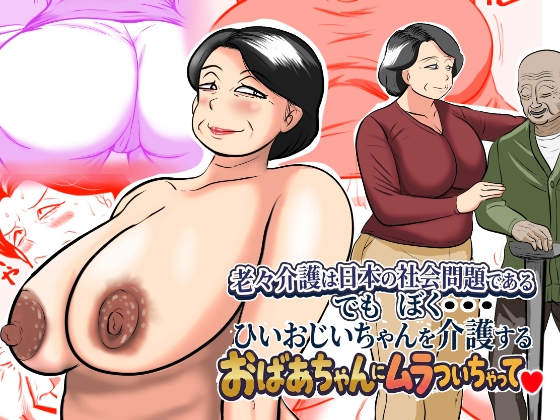
A derived subgenre is the care genre, thematising a process in which an elderly man in need of care reaches sexual contact while being cared for by a young female caregiver, granddaughter, or helper. It carries its own moral tension in turning the social problem of elderly care into sexual fiction; the heroine bearing professional or familial responsibility for care distinguishes it from the typical elderly-man pattern, and the bodily vulnerability of the cared-for is paradoxically turned into the agency of harm. Where a blood relationship is involved (“grandfather and granddaughter”), it may or may not combine with the incest tag; for the sake of commercial-distribution compliance, dramaturgy that avoids an explicit blood setting is generally common.
The elderly male-actor genre in AV
The age division of male actors in commercial AV was long described in two poles, “young actor” and “middle-aged actor”, but from the 2000s a group of works casting elderly male actors developed as an independent niche category. Yasuda’s A Complete History of Japanese Erotic Magazines (2019) frames this genre subdivision as an industrial phenomenon responding both to the market’s maturation and to the increasing visibility of elderly consumers. The “elderly man and young woman” AV mainly aims at the contrast with the youth and innocence of a project actress, or at the age-gap-reducing effect of a mature-woman actress. Series names such as “lecherous old man”, “grandfather and granddaughter”, and “care ward” circulate, holding a fixed but niche fan base, functioning as a market layer separate from the mainstream. Because the appearance of elderly male actors always involves issues of stamina and health management, shooting schedules and scripts require considerations different from ordinary works, which limits the genre’s production volume and keeps it niche.
Comparison with abroad
In English, the elderly-man and young-woman genre is named by several terms: grandpa, older man, dirty old man, and DILF (the symmetrical coinage to MILF, circulating from the 2000s, with a target age generally somewhat younger, around the forties and up). The English older man / younger woman genre is larger than the Japanese in both production and market size and is widely recognised as an independent category. The dramaturgical tone differs, however: in English the framing of “educational eros by an experienced elder” is dominant, while the Japanese elderly-man genre centres on dramaturgy that emphasises a transgressive, perverse gap. In Chinese-speaking regions, laoyeye serves as an endearment and laoseigui (“lecherous old man”) as a genre term; in Korean, yeonggam (an old endearment for an elderly man) partly corresponds, though the romanised ojiichan is sometimes imported as a loanword in subcultural contexts.
Symmetry with the mature-woman genre
The symmetry with the mature-woman genre gives an important view of the elderly-man genre’s cultural position. Both thematise the elderly as sexual objects, but there is a large asymmetry in sex, reception structure, market size, and gender implication. The mature-woman genre has long maintained a stable market as one of the major genres of commercial AV, with both the Japanese jukujo and the English MILF circulating as popular terms and many dedicated labels and sites. The elderly-man genre, while achieving genre status on the doujin and adult-game side, remains niche on the AV side, its market said to be a fraction of the mature-woman genre’s. This asymmetry reflects a commercial-porn structure in which the principal originator of the sexual gaze remains weighted toward the male side; where the mature-woman genre developed as a major genre paired with the young-woman side, the elderly-man genre remains peripheral.
The structure of reception
Several factors are cited for why the genre sustains a stable niche demand. The half-century age gap itself has the greatest efficiency as a gap device: where the gaps of fat-man and kimomen lie in the relatively malleable dimensions of build and appearance, the gap of elderly man and beautiful young woman lies in the irreversible dimension of time, and that irreversibility produces a peculiar emotional drive. The mobilisation efficiency of social taboo is high: in a present that does not widely make the sexual agency of the elderly visible, the “lecherous old man” type functions as a device that surfaces a desire supposed to be hidden. The genre also bonds strongly with cuckolding, kichiku, and assault-themed works; in the configuration where the heroine yields to the least fitting partner, the elderly man, alongside kimomen and fat-man, is a principal option for the harming-side character, the three forming a mutually substitutable “unhandsome-man and beautiful-girl” triangle, each carrying a different emotional code.
See also
Updated
References
- 『Eromanga Studies: An Introduction to Manga as a Pleasure Apparatus』 East Press (2006)
- 『Erotic Comics in Japan: An Introduction to Eromanga』 Amsterdam University Press (2021)
- 『A Complete History of Japanese Erotic Magazines』 Ohta Publishing (2019) — On the subdivision of age genres in the AV industry.
Also known as
- grandpa (genre)
- older man
- DILF
- ja: おじいちゃん
- ja: 高齢男性
Related
- Jukujo (mature woman)
- Mind Break (Hentai Tag and Narrative Type)
- Demon Girl Moe (Akuma Chara)
- Bakajoshi (Airhead Girl Archetype)
- Debu Otoko (Fat Bastard / Ugly Bastard)
- Dosukebe (Super-Lewd Character Type)
- Twins Moe (Futago Moe)
- Step-Parent Theme (Giri no Oya-kei)
- Haraguro Moe (Two-Faced Character Appeal)
- Ishukan
- Kemonomimi (beast-ear character)
- Netorase (consensual cuckolding)