Seitenkan (Gender Transformation Genre)
✎ 本文編集 (admin) 🖼 画像編集 (admin)“Seitenkan (Gender Transformation Genre)” works on DLsite


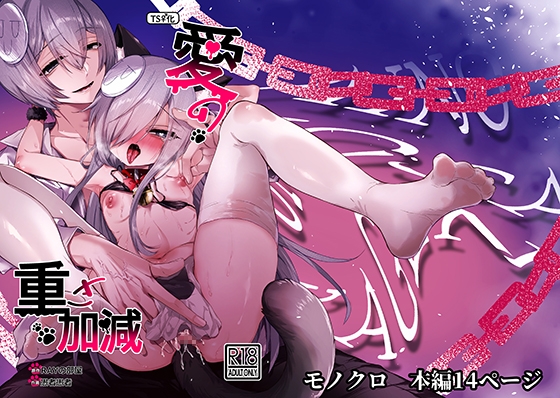

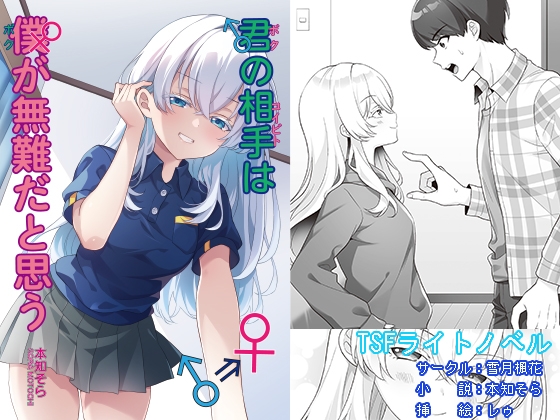



The self-evidence of sex, supposedly rooted deep in the body, reversed one morning without warning. As a thought experiment only fiction permits, the gender-transformation genre forms a lineage of its own.
Seitenkan (性転換, gender transformation) is the character-type and story-type, in adult manga, eroge, doujinshi and other fiction, in which a protagonist’s bodily sex is physically swapped. It corresponds to the Anglophone gender bender type, and in Japanese subculture circulates under the abbreviations TS (Trans Sexual) or TSF (Trans Sexual Fiction). This article treats only the cultural history of the fictional genre; for medical sex reassignment and gender identity, see transgender.
Overview
The genre sets at its core a premise in which bodily sex is swapped by a physical, supernatural, or science-fictional trigger. The male-to-female type (M→F) holds the quantitative centre, followed by the female-to-male type (F→M) and round-trip types. Triggers vary: magic and divine intervention, drugs and surgery and genetic manipulation, body-swap supernaturalism, and transformation by tentacle or parasite. The weight of the work tends to fall less on the necessity of the cause than on the wavering of the post-transformation body, self-awareness, and social relations.
This is a fictional field strictly distinct from real transgender people and the clinical reality of gender-affirming medicine. The article’s policy is to keep to cultural-historical description of the fictional type, independent of any structure that consumes real people as sexual objects.
Etymology and abbreviations
The Japanese seitenkan is an existing scientific term for sex change, originally denoting the sex-reversal seen in fish and crustaceans and, in medicine, sex reassignment surgery (SRS). Its subcultural use borrows this vocabulary as a fictional genre name. The English-derived abbreviations include TS (Trans Sexual), TSF (Trans Sexual Fiction), and TSR (Trans Sexual Reincarnation, the “isekai-reincarnation TS” type). TSF in particular was used earlier in 1990s Anglophone fan culture, notably U.S. SF fandom, and Japanese subculture fixed it through import. In Anglophone literature and subculture generally, gender bender is widely used, with TSF coexisting as a more specialist abbreviation.
History
The story-element of sex reversal exists across world literature and myth: the dual-sex experience of Tiresias in Ovid’s Metamorphoses, the swapped cross-dressing siblings of the Japanese Torikaebaya Monogatari (late twelfth century), and the cross-dressing comedies of Shakespeare. Torikaebaya in particular, depicting the wavering of body, mind, and social position attending a male-female swap, can be seen as a distant ancestral form of the modern genre.
In postwar Japanese manga and SF, sex-transformation works appeared sporadically. Osamu Tezuka’s Marvelous Melmo (1971) and Rumiko Takahashi’s Ranma ½ (serialised from 1987), whose hero swaps sex on contact with water, are representative examples in children’s and general works that directly influenced the later TSF imagination. In Anglophone SF, Ursula K. Le Guin’s The Left Hand of Darkness (1969) is a landmark thematising the fluidity of sex, and reached Japanese SF readers in translation.
The independent formation of the fictional genre (TSF) is found in the development of 1990s doujinshi culture. Among adult works distributed at conventions, sex-transformation works formed a distinct genre, and through the accumulation of specialist circles, anthology magazines, and online communities settled as a proper subcultural field by the 2000s. From the 2000s the genre spread into commercial adult manga, eroge, and adult anime, with specialist magazines and labels in circulation.
Derived forms
In the M→F lineage, the quantitative centre, the work narrates surprise at the new bodily sensation, bewilderment at the social gaze met as a woman, and the divergence, integration, or collapse of an inner male self-awareness against an outer female body. The “mind stays male, only the body changes” premise recurs, holding the continuity of self-awareness across the change so that the reader can imaginatively identify. The F→M lineage is quantitatively smaller but has its own development in women’s doujin circles and yuri-adjacent settings, treating the acquisition of sexual agency, the enjoyment and unease of social privilege, and divergence from a female self-awareness.
At the opposite pole from “mind stays male” lies a type in which transformation is accompanied by a mental shift toward a female self-awareness, connecting to the mesu-ochi lineage. This crossing region, joining transformation with identity collapse, is the most polarising series within TSF.
Appeal in two-dimensional culture
Several psychological and narrative motors overlap. First, the wavering of identity-continuity: keeping the continuity of “self” while the body reverses offers a thought experiment about the ground of self-identity, simulated within the safety of fiction. Second, the acquisition of a forbidden gaze: the M→F type offers the male reader the pseudo-acquisition of experiencing a female body from the inside, a viewpoint unreachable in reality, reorganising the objectification of desire into internalisation and identification. Third, the experience of social-position reversal: depictions of how differences in social treatment by sex assail the protagonist after transformation give the genre a sociological aspect that has come to the fore in recent works. Fourth, attraction to transformation itself, a transformation fetish that forms a sub-kink shared with the Anglophone TF community.
Distinction from real medical transition
What this article treats is sex transformation as a fictional premise, strictly distinct from gender-affirming care, SRS, and hormone therapy. Whereas TSF works use instantaneous, complete bodily reversal as a story device, real gender-affirming medicine is a long-term, staged, multi-domain set of interventions centred on the individual’s self-determination, human rights, and social inclusion. Overlaying the two on a narrative or imaginative plane risks a misreading that effaces the reality of real people, and is a matter of careful handling repeatedly discussed from within the genre itself in its mature period. For detail, see transgender.
See also
Updated
References
- 『Hentai Manga! A Brief History of Pornographic Comics in Japan』 Fakku (2019) — English-language adult-manga genre history including the TSF lineage.
- 『Eromanga Studies』 East Press (2006) — Representative work on adult-manga genre history.
- 『The Left Hand of Darkness』 Ace Books (1969) — Foundational SF work thematising the fluidity of sex.
Also known as
- gender bender
- TS (Trans Sexual) genre
- gender transformation genre
- ja: 性転換
- ja: 性転換もの
Related
- Futanari
- Shussan-mono (Childbirth-Themed Genre)
- Debu Otoko (Fat Bastard / Ugly Bastard)
- Gangimari (Drugged-Face Expression)
- Ahegao
- Kimomen (Ugly Bastard)
- Mitsuyu (Excessive Wetness)
- Mesu-ochi (Falling into Female Submission)
- Kankin (Confinement)
- Roshutsu (Exhibitionism)
- Isekai genre (Japanese fantasy/adult setting)
- Classroom-setting genre (J-adult fiction)